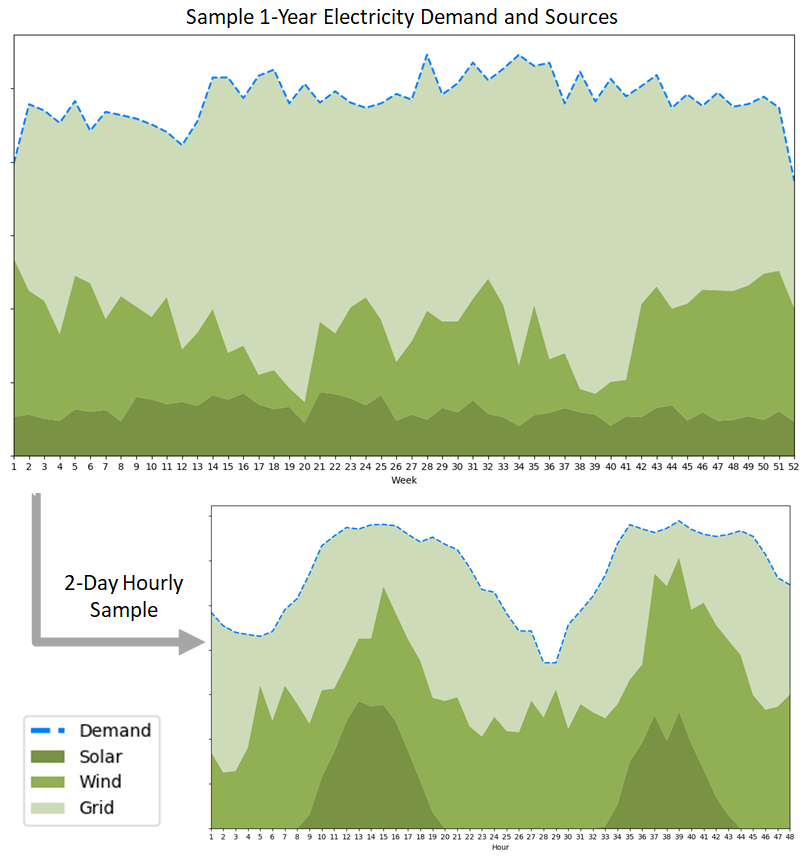
The combination of energy technologies with their respective installed capacities is called the energy mix. The capacity or size of the energy technology is defined in terms of kW or MW for generation technologies and kWh or MWh for storage technologies. The energy mix is illustrated below shows that electricity can be coming from multiple sources. In this example, the electricity demand is fulfilled by solar, wind and electricity from the grid. The energy mix can affect the sustainability of the project. For example, the sizes of the energy technologies cannot be too high that will make the project expensive and the electricity cost unaffordable for the consumers. It cannot also be too low as the energy demand and expectations of the community will not be satisfied. Thus, there is an optimal energy mix and there are available methodologies and software tools to solve and determine this.
To provide a solution of energy mix, multiple sources of energy should be available as alternatives. With the cost competitiveness of renewable energy technologies, these systems are typically hybrid renewable energy systems that can be coupled with energy from conventional generators and the grid. An example of the portfolio of energy technologies available in a tool is shown below:
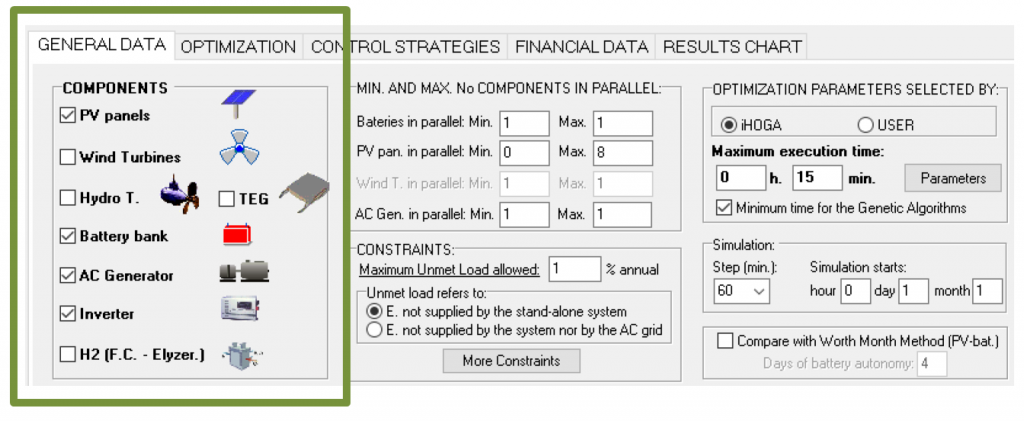
Source: Dufo-López, R., and J. Bernal-Agustín. “iHOGA User Manual.” Faculty of Engineering, University of saragossa, spain (2020).
The tool should be able to identify the optimal combination of energy technologies. This is in contrast to simulation of only one or several scenarios of energy mix. The primary purpose of simulation is to predict generated energy and to assess system performance. The tool should be capable of either systematically simulating multiple scenarios and/or apply traditional optimization techniques with the goal of finding the best-case sizes of energy technologies.