Another important factor that can persuade potential developers in the energy industry is investment recovery. If a particular power plant cannot recover the financial cost of building and operating it through the electricity it produces and sells, then it is not economically viable. Measuring the energy efficiency of an energy generating technology or system can be determined using the Energy Return On Investment (EROI). EROI is a means of measuring the ability of an energy technology in providing energy efficiently by calculating the ratio between the energy delivered by the system and the energy required to build, operate, maintain and dismantle it.[1] EROI is important because it can help policymakers and private developers in deciding which systems are more profitable than others.
A high EROI indicates cost-effectiveness or even profit for an energy system or technology while a low number indicates generating energy from that particular source is expensive. An EROI value of 7 is considered break-even[2] while some studies argue that an EROI value of 1 is the minimum requirement for a technology to be energetically sustainable.[3]
In its simplest form, the formula for EROI is described in Equation (2).[4]
EROI = Total Energy Output / Total Energy Input
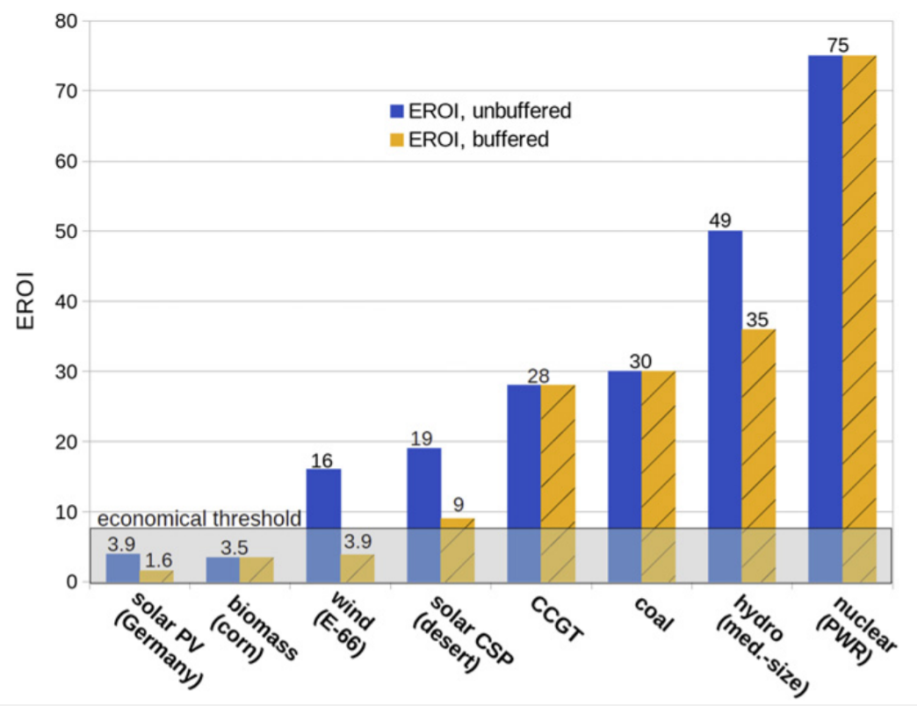
Source: WEISSBACH ET AL; “COMPARISON WITH OTHER RESULTS”; ENERGY INTENSITIES, EROIS (ENERGY RETURNED ON INVESTED), AND ENERGY PAYBACK TIMES OF ELECTRICITY GENERATING POWER PLANTS
| 2010 | 2030 | 2050 | |
| Biomass with CCS | – | – | – |
| Biomass and waste | 11.4 | 6.3 | 5.9 |
| Ocean | 5.5 | 2.4 | 2.9 |
| Geothermal | 5.4 | 5.2 | 5.1 |
| Solar CSP | 21.6 | 8.9 | 9.1 |
| Solar PV | 9.3 | 7.4 | 7.2 |
| Wind offshore | 9.4 | 11.0 | 10.5 |
| Wind onshore | 9.5 | 9.3 | 8.1 |
| Hydro | 13.2 | 11.9 | 11.9 |
| Nuclear | 10.5 | 7.3 | 7.0 |
| Gas with CCS | – | – | 7.5 |
| Coal with CCS | – | – | 6.2 |
| Oil | 8.4 | 9.8 | 9.9 |
| Gas | 13.9 | 15.0 | 14.9 |
| Coal | 12.9 | 11.5 | 11.5 |
| TOTAL | 12.2 | 10.9 | 10.7 |
EROI’s and share in electricity mix of energy technologies using the THEMIS model for business-as-usual scenario
Source: ADRIEN FABRE. “ESTIMATION OF CURRENT AND FUTURE EROI’S USING THEMIS.” EVOLUTION OF EROIS OF ELECTRICITY UNTIL 2050: ESTIMATION AND IMPLICATIONS ON PRICES
[1] Adrien Fabre, Evolution of EROIs of electricity until 2050: Estimation and implications on prices, 3.
 [2] Daniel Weissbach et al., Energy intensities, EROIs (energy returned on invested), and energy payback times of electricity generating power plants, 5.
 [3] Adrien Fabre, Evolution of EROIs of electricity until 2050: Estimation and implications on prices, 1.
 [4] Paul Brockway et al., Estimation of global final-stage energy-returnon- investment for fossil fuels with comparison to renewable energy sources, 1.