Calculating generation cost is one way to determine whether a particular energy technology is cost-effective and worthy of investment. Moreover, the ability to compare costs using different technologies is crucial for developing investment strategies, policies and deciding budgets.[1] Generation costs can be expressed through the levelized cost of energy (LCOE), a commonly used metric to assess cost competitiveness of power generation technologies. It represents the net present value of the unit cost of electricity during the lifetime of a particular electricity generation technology[2] and compare it to that of other generation technologies. The main strength of the LCOE is that it compresses all the direct technology costs into a single metric, including those related to construction, fuel, carbon prices, operations and maintenance.[3] It is a widely accepted tool for modeling, policy making and public debate.
In a report by the International Energy Agency on estimated generation costs of various technologies existing across the globe by 2025, the LCOE can be calculated using Equation (1) where t is the year of sale of production, the summation S is from the start of construction preparation to the end of dismantling, and r corresponds to the discount rate according to the cost of capital.
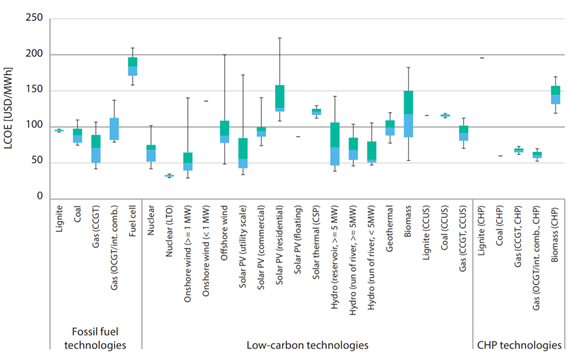
Source: INTERNATIONAL ENERGY AGENCY; “LCOE VALUES BY TECHNOLOGY AND COUNTRY”; PROJECTED COSTS OF GENERATING ELECTRICITY
[1] Ibrahim Dincer et al., Comprehensive Energy Systems, 288.
[2] USAID and U.S. National Renewable Energy Laboratory, Exploring Renewable Energy Opportunities in select Southeast Asian Countries, 1.
[3] IEA, Projected Costs of Generating Electricity, 75.