Within battery energy storage systems for grid applications, Lithium-ion (Li-ion) technology is receiving the most attention and investment for grid reliability and stabilization in terms of RE capture, load leveling, and avoidance of brown-outs and black-outs in critical applications.[1] Li-ion chemistries also have the highest energy density and is considered one of the safest as shown in Figure 49. Other battery chemistry types include Lead-Acid (PbA) which is widely used in vehicles and other applications requiring high load current, Nickel-Cadmium (Ni-Cd) which is widely used for small battery-operated devices requiring an even power discharge, Sodium-Sulfur (Na-S) which is a type of molten metal battery primarily used for large-scale non-mobile applications, and the Redox Flow Battery (RFB) which has a long service life free of combustible materials despite having a complex means of operation.[2]
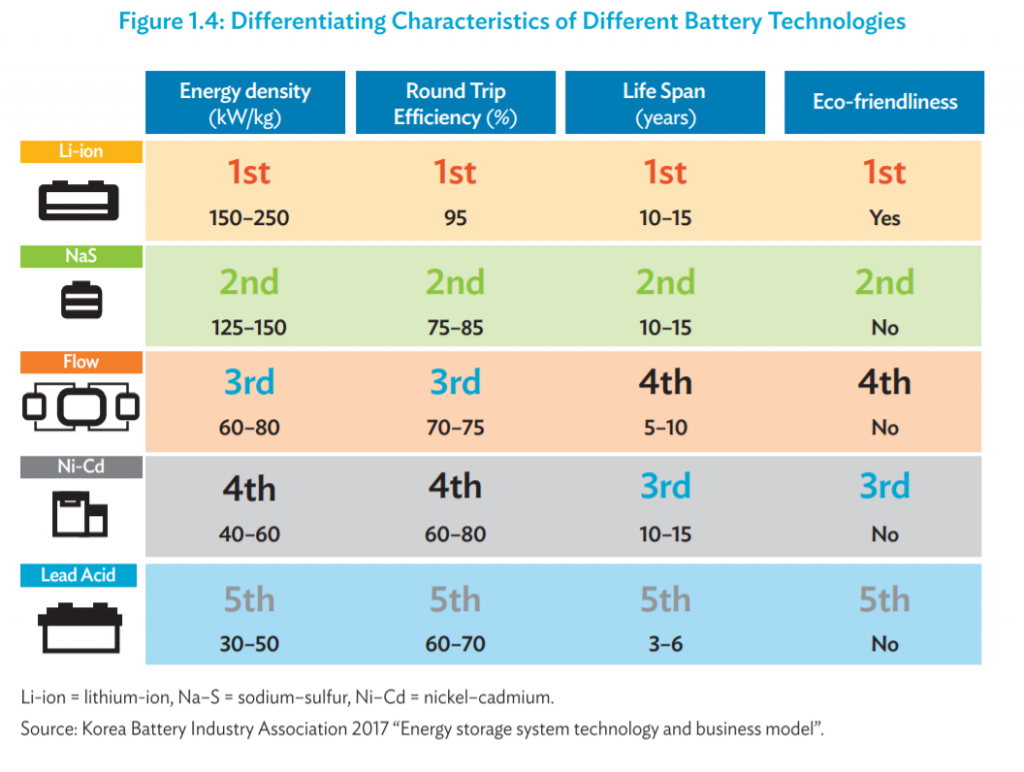
Source: ASIAN DEVELOPMENT BANK; “STORAGE TYPES”; HANDBOOK ON BATTERY ENERGY STORAGE SYSTEM
[1] Ibrahim Dincer et al., Comprehensive Energy Systems, 656.
[2] ADB, Handbook on Battery Energy Storage System, 9-14.