The 1970’s oil crisis prompted government then under the Marcos administration to look for an alternative energy source which led to the construction of the Bataan nuclear power plant (BNPP).[1] However, the ready-to-operate[2] 2 billion USD facility was closed down shortly after Marcos was removed from power and also because of fears raised by the Chernobyl disaster[3]. To date, the BNPP remains unused, its fuel rods sold and shipped abroad yet maintenance by the NPC continued.[4] A renewed interest led to study groups from the IAEA and Korea Electric Power Corporation (KEPCO) to inspect and conduct feasibility evaluations of reviving the Philippine nuclear program. In 2016, the government established the Philippine Nuclear Energy Program Implementing Organization (NEPIO) as one of the recommendations by the IAEA[5] then four years later, Executive Order 116 was issued directing a study for the adoption of a national position on a nuclear energy program.[6]
Potential sites were identified with the requirement of being located near the sea in order to provide abundant cooling water.[7] Figure 46 shows the twelve proposed sites for nuclear power plants which are accessible by land transportation and are within reasonable distance of transmission lines.
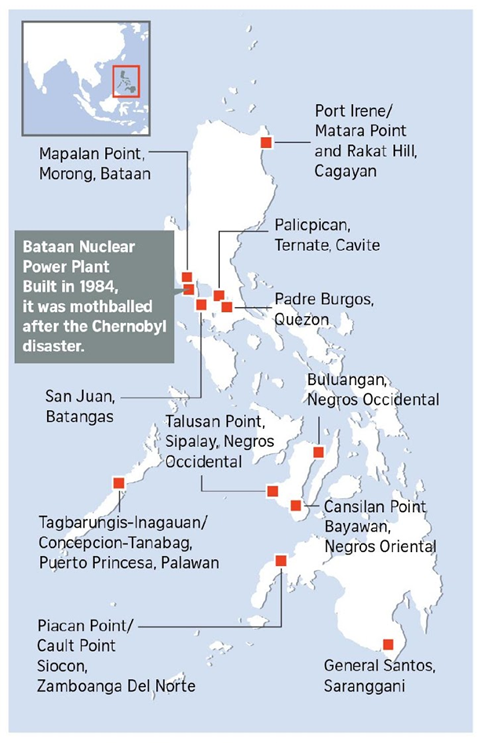
Source: THE STRAITS TIMES; “IN POWER HUNGRY PHILIPPINES, SOME ADVOCATE A NUCLEAR REVIVAL”; WWW.STRAITSTIMES.COM/ASIA/SE-ASIA/IN-POWER-HUNGRY-PHILIPPINES-SOME-ADVOCATE-A-NUCLEAR-REVIVAL
[1] International Atomic Energy Agency, Country Nuclear Power Profiles: The Philippines
[2] Josef Yap, Revisiting the Nuclear Option in the Philippines, 4.
[3] IAEA, Country Nuclear, 12.
[4] Arangkada Philippines and USAID, A Policy Brief on the Philippine Power Sector, 23.
[5] DOE, Philippine Energy Plan 2018-2040, 185.
[6] Josef Yap, Revisiting the Nuclear Option in the Philippines, 1.
[7] International Atomic Energy Agency, Country Nuclear Power Profiles: The Philippines 2015, 18. 2015, 12.