The principle behind the KeyMaker model is based on having the mini-grid operator to take advantage of an established and well managed network providing a stable supply of electricity to qualitatively improve a strategic value chain in the local community, often on the agriculture processing and trading sectors. The electricity supplier in turn becomes an agro-product processor. As a result, the farmers’ produce is now locally processed and well-preserved while marketed beyond the local community to reach regional, national or international markets, freeing the community from the economic constraint implied by its remote location.[1]
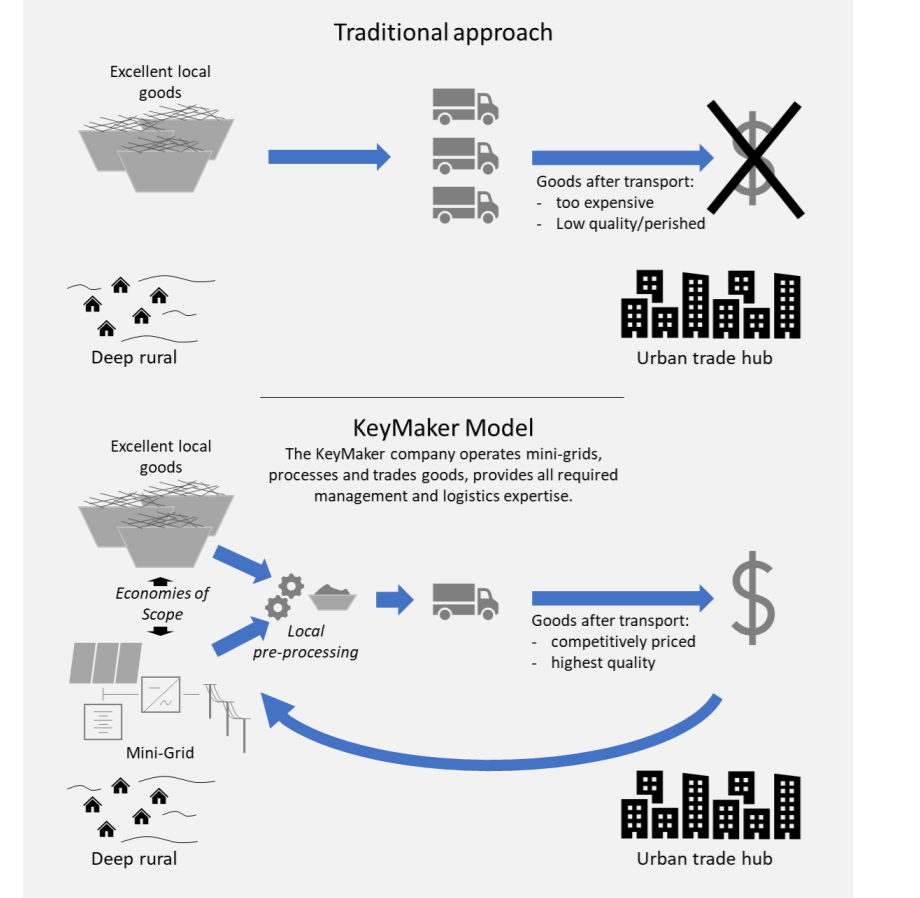
Source: INENSUS GMBH; “ECONOMIC INCLUSION OF DEEP RURAL AREAS USING THE KEYMAKER MODEL”; KEYMAKER MODEL FUNDAMENTALS
[1] Andrea Cabanero et al., Mini-Grids for the Sustainable Electrification of Rural Areas in Sub-Saharan Africa: Assessing the Potential of KeyMaker Models, 2.