Access to energy is essential in meeting basic needs and attaining an improved quality of life for individuals. It has been defined as the provision of adequate amounts of high-quality and reliable modern energy supplies when needed and as the ability of individuals to purchase such supplies in the amounts deemed necessary for their daily use.[1] It is instrumental in reducing poverty, crucial to a country’s economy and it ensures sustainable development therefore access to energy must be available to all.
Using these prevalent concepts, frameworks which put prime on sustainability are prioritized and will be utilized to serve as guides for organizing systems into regulated structures that developers can use to build programs such as those for expanding access to household electricity. Frameworks such as the UN Global Compact for Sustainable Energy, Sustainable Energy Access Planning, Derisking Renewable Energy Investment, Regulatory Indicators for Sustainable Energy and the Multi-Tier Framework are fundamental to the scope of this report.
UN Global Compact for Sustainable Energy Framework
The United Nations (UN) with its partners developed the UN Global Compact for Sustainable Energy framework which identifies and shapes the role of businesses in achieving sustainability targets centered on energy development by 2030. The 2012 UN General Assembly outlined these targets in the “Sustainability For All (SE4ALL)” initiative, and they are universal access to modern energy services, improving energy efficiency and increasing the utilization of renewable resources.
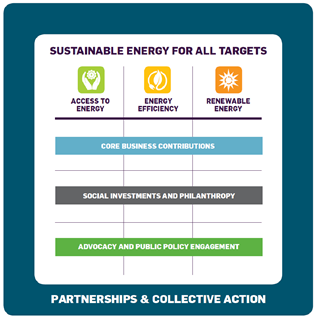
Source: UN Global Compact
Sustainable Energy Access Planning Framework
Developed by the Asian Development Bank (ADB) through their Energy for All Initiative which seeks to maximize access to energy by providing an improved framework and assessment basis to shape responses and build better solutions, the sustainable energy access planning (SEAP) framework has features that are distinct from traditional electricity and energy planning frameworks. The identification of cost-effective and sustainable resource and technology options for providing universal access to basic energy services as well as the assessment of the affordability of cleaner-energy service options to energy-poor households are among its main objectives.
This framework focuses on social inclusiveness and takes into account the ability of even the poorest households in gaining access to electricity and other cleaner forms of energy to meet their basic energy needs for lighting, cooking and heating. It also considers the acceptable minimum level of basic energy services to the energy poor and uses tools to assess the energy demand of non-poor households.
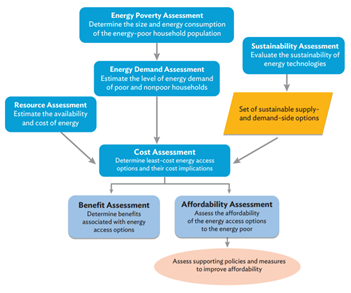
Source: ADB, Sustainable Energy Access Planning: A Framework
Derisking Renewable Energy Investment Framework
The Derisking Renewable Energy Investment (DREI) framework aims to assist policymakers in developing countries to cost-effectively promote investment in renewable energy by utilizing publicly-available methodologies, financial tools, models and resources.
The DREI framework was launched in 2013 by the United Nations Development Programme (UNDP) and was originally focused on utility-scale renewable energy. Recently it has taken on an energy access expansive nature by extending to on-grid rooftop PV, off-grid solar home systems and off-grid solar mini-grids. The overall aim of the framework is to cost-effectively achieve a risk-return profile that encourages private sector investment.[2]
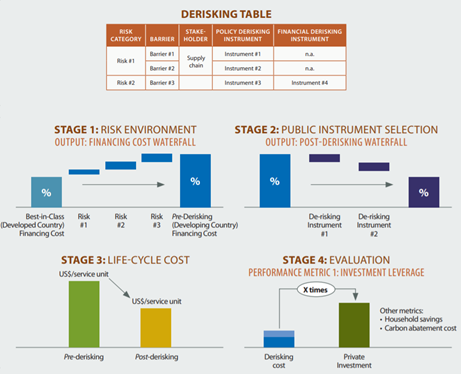
Source: UNDP, Derisking Renewable Energy
[1] G20 2016 China, Enhancing Energy Access in Asia and the Pacific: Key Challenges and G20 Voluntary Collaboration Action Plan, http://www.g20.utoronto.ca/2016/enhancing-energy-access-in-asia-and-pacific.pdf.
[2] UNDP, Derisking Renewable Energy Investment: Off-Grid Electrification, 27.