EPIRA covers the four sectors of the electric power industry: generation, transmission, distribution, and supply. EPIRA defines said sectors, as follows:
- Generation of Electricity refers to the production of electricity by a generation company or a co-generation facility
- Transmission of Electricity refers to the conveyance of electricity through the high voltage backbone system
- Distribution of Electricity refers to the conveyance of electric power by a distribution utility through its distribution system
- Supply of Electricity means the sale of electricity by a party other than a generator or a distributor in the franchise area of a distribution utility using the wires of the distribution utility concerned
Under EPIRA, there are two ways electricity is provided to a household: grid and off-grid. A household is considered to be serviced through the grid if electricity access is provided through local connections from a main grid.
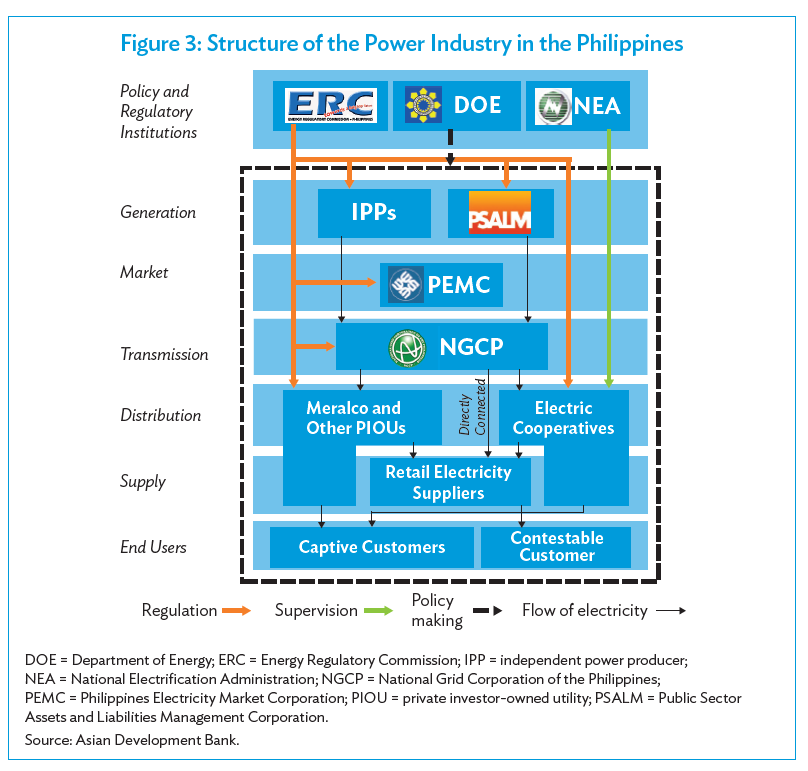
Figure: Structure of the Power Industry in the Philippines[1]
In the context of the Philippines, consumers located in larger islands are generally connected to a main grid system (i.e. Luzon Grid, Visayas Grid, Mindanao Grid), while those geographically unable to connect to the main grid make use of small islands and isolated grids (SIIGs) whose supply is provided by the NPC-Small Power Utilities Group (NPC-SPUG), privately-owned New Power Providers (NPPs) and Qualified Third Party (QTP) providers.[2]
[1] Asian Development Bank, “Philippines Energy Sector Assessment, Strategy, and Road Map”

[2] Philippine Energy Plan 2020