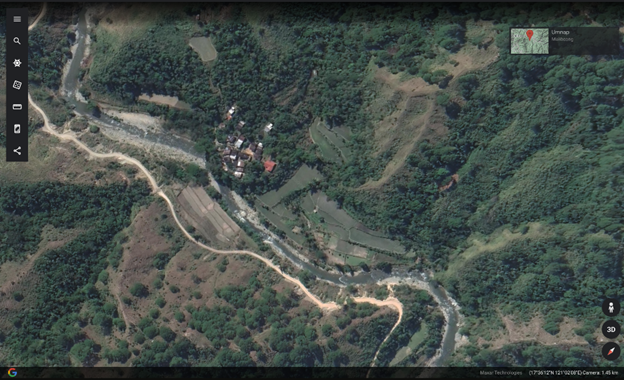
Sitio Adugao of Brgy. Umnap in the Municipality of Malibcong has a population of 60 people, which comprises 17 households. The main source of livelihood in Sitio Adugao is rice farming, with 2 harvests in a year. Kaingin for vegetable farming is also practiced, as well as poultry farming and raising livestock such as carabao to sustain the farming activities. Each household has their own fish pond for their own consumption. Aside from farming, the residents are also engaged in carpentry, woodwork and metal works.
The MHP in Adugao was constructed in 1997 after it was introduced with the promise of providing lighting to the community. The elders were encouraged by the demonstration of the MHP in Dulao and the change that it can bring to the quality of life of the community. The materials were provided by UNDP and Sibat, Inc., while the community provided free labor which entailed transporting the materials from the main highway to the community and building the MHP system.
[1] Image from Google Earth.]]>
In order to facilitate and streamline the process for entry of QTPs, the DOE issued the Revised Guidelines for Qualified Third Party or “Revised QTP Guidelines”[1] issued by the DOE on November 22, 2019 to encourage private sector participation. As stated in the Revised QTP Guidelines, the participation as a QTP shall be open to any party, including but not limited to private firms, local government units, cooperatives, non-government organizations, generation companies or their subsidiaries or subsidiaries of DUs who have demonstrated the capability and willingness to comply with the relevant technical, financial, and other requirements. This will be done through a competitive bidding. However, a DU or its subsidiary is not qualified to participate as a QTP for the areas it has waived. All QTPs are mandated to adopt the least-cost and most efficient technology options in serving QTP service areas.[2]
PV Mainstreaming
To further contribute to the policy of the State to promote the sustainable development in rural areas through rural electrification, there is recognition that Solar Home Systems (SHS) can be used to provide least-cost and quality service to areas which are unviable for a conventional distribution system.[3] To accelerate household electrification in off-grid and isolated areas through the use of SHS, there is a need to establish a benchmark tariff for SHS electricity service.[4] Hence the promulgation of Resolution No. 17, series of 2017 or the Rules Governing the Setting of Regulated Solar Home System Tariff for the Provision of Electricity Service for Rural Electrification by Electric Cooperatives on July 17, 2017 by the ERC.
Republic Act No. 11357
On July 31, 2019, Republic Act No. 11357 or the Solar Para Sa Bayan Corporation (SPSB) Franchise was passed into law. It grants SPSB a non-exclusive franchise to construct, install, establish, operate, and maintain distributed energy resources (DERs) and microgrids in remote and unviable, or unserved or underserved areas in selected provinces of the Philippines to improve access to sustainable energy.[5]
The law allows SPSB to operate in the following areas:
- In the barangays, municipalities, and cities of the following provinces: Aklan, Aurora, Bohol, Cagayan, Camiguin, Capiz, Compostela Valley, Davao Oriental, Guimaras, Isabela, Masbate, Misamis Occidental, Occidental Mindoro, Oriental Mindoro, Palawan, and Tawi-Tawi;
- In the municipalities and cities of Agoncillo, Alitagtag, Balayan, Balete, Bauan, Calaca, Calatagan, Cuenca, Ibaan, Laurel, Lemery, Lian, Lipa, Lobo, Manibi, Malvar, Mataas na Kahoy, Nasugbu, Padre Garcia, Rosario, San Jose, San Juan, San Luis, San Nicolas, Santa Teresita, Taal, Talisay, Tanauan, Taysan, Tingloy, and Tuy in the province of Batangas;
- In the municipalities and cities of Agdangan, Alabat, Atimonan, Buenavista, Burdeos, Calauag, Catanauan, General Luna, General Nakar, Guinayangan, Gumaca, Infanta, Jomalig, Lopez, Macalelon, Mulanay, Padre Burgos, Panukulan, Patnanungan, Perez, Pitogo, Plaridel, Polilio, Quezon, Real, San Andres, San Francisco, San Narciso, Tagkawayan, and Unisan in the province of Quezon.[6]
SPSB is given a term of 25 years for the franchise, from the date of the law’s effectivity, or until 2044, unless sooner cancelled or revoked.[7] The franchise granted to SPSB does not revoke any existing franchise and no waiver of rights from distribution utilities with franchises shall be necessary to operate distributed energy resources or microgrids in remote and unviable, unserved, or underserved areas, as determined by the DOE.[8] In addition, the law dictates that the franchise shall not affect the duty of the DOE to promote competition in the electrification of remote and unviable, unserved, or underserved areas. Furthermore, other QTPs will be able to operate in any remote and unviable, unserved, or underserved areas, as determined by the DOE, even without a similar franchise from Congress.[9]
[1] Department Circular No. 2019-11-0015
[2] (Sec. 2, Department Circular No. 2019-11-0015)
[3,4] ERC Resolution No. 17, s. 2017
[5-9] Section 1 REPUBLIC ACT NO. 11357
]]>
On April 12, 2019, Republic Act No. 11285 or the Energy Efficiency and Conservation Act was passed into law to institutionalize fundamental policies on energy efficiency and conservation (EE&C), promoting the efficient and judicious use of all energy resources, and increasing the use of energy-efficient and renewable energy technologies.[1] The law is intended to promote and encourage the development and utilization of efficient renewable energy technologies and systems to ensure optimal use and sustainability of the country’s energy resources, and to ensure a market-driven approach to energy efficiency, sufficiency, and sustainability in the country.[2] One way of doing this is directing national government agencies and instrumentalities from implementing energy efficient practices. The law also expressly emphasizes the role of all energy end-users. Section 8 of the law states that all energy end-users shall use every available energy resource efficiently and promote the development and utilization of new and alternative energy efficient technologies and systems, including renewable energy technologies and systems.
Uniform Monthly Electric Bill Framework
Policies that are more directed towards improving the distribution sector also contribute to or affect access to energy. One such policy is the Uniform Monthly Electric Bill Framework[3] issued on September 14, 2018. The framework provides a mandatory format for all entities issuing electricity bills to reflect all corresponding charges, including but not limited to generation, transmission and ancillary services, distribution, supply and metering services, universal charges and bill deposits, subject to the rules and regulations that the ERC may promulgate.[4]
[1,4] Philippine Energy Plan 2020
[2] Sec. 2, Republic Act No. 11285)
[3] Department Circular No. 2018-08-0026
]]>
On August 8, 2019, Republic Act No. 11371 or The Murang Kuryente Act of 2019 was enacted. The law seeks to protect public interest by ensuring the provision of reliable, secure, and affordable supply of electric power to consumers. To this end, the law was passed to minimize the universal charges (UC) for stranded contract costs (SCC) and stranded debts (SD).[1] The law allows the utilization of the government’s share worth PhP 208 Billion from the Malampaya fund for the payment of stranded contract costs and stranded debts of the NPC.[2] Prior to this law, end-users contribute to the payment of the stranded contract costs and stranded debts as part of the universal charge.[3]
Competitive Selection Process
Another policy affecting cost is the competitive selection process (CSP) in the procurement by the DUs of power supply agreements for the captive market.[1] Issued on February 1, 2018, the CSP policy promotes competition and greater private sector participation in the provision of least-cost, reliable, and adequate supply of electricity by instituting a supply procurement process that is clear, transparent and fair. It follows the principles of (i) transparency in the CSP through wide dissemination of bid opportunities and participation of all generation companies; (ii) competitiveness, by extending equal opportunity to eligible and qualified generation companies to participate in the process; (iii) simplicity and efficiency in a streamlined procurement process; and (iv) accountability in the procurement process and implementation of the power supply agreements awarded under the CSP.[2]
Under this policy, DUs are required to establish a Third-Party Bids and Awards Committee (TPBAC) or Joint TPBAC or may opt to engage a Third-Party Auctioneer in lieu thereof. The TPBAC/Joint TPBAC is an independent body that will spearhead and manage the CSP.[3]
[1,2] Republic Act No. 11371
[3] Philippine Energy Plan 2020
[4,5,6] Department Circular No. 2018-02-003
]]>
For the government, total electrification does not only involve ensuring that rural and far-off places have access to electricity through the ECs. As part of its policy for total electrification, the DOE also envisions the interconnection of the three major grids in Luzon, Visayas, and Mindanao in order to achieve the ultimate goal of a unified national grid or the “One Grid Philippines”.[1] At the moment, only the Luzon and Visayas grid are interconnected through submarine cables. The Mindanao-Visayas Interconnection Project (MVIP) is therefore of the highest priority in order to share system reserves between Visayas and Mindanao and to reduce operating costs due to the economic dispatch of generators. By connecting these two major grids through the western seaboard (Zamboanga del Norte-Cebu interconnection), lesser investments in power generation will also be needed to maintain the one-day Loss of Load Probability (LLOP). According to the PEP, it will further help optimize the use of available energy resources and additional generation capacities in the country.[2]
Smart Grid Policy
In 2013, the DOE issued Department Circular No. 2013-03-003 creating an Inter-Agency Steering Committee to develop a comprehensive and holistic smart grid policy framework and roadmap.[3] This comes after the United States-Department of Energy stated that a smart grid can reduce the frequency and duration of power outages, limit storm impacts, and restore service faster when outages occur. The delivery of electricity can be performed more efficiently and reliably with the use of cutting-edge technologies, equipment and controls.[4]
[1,2,3,4] Philippine Energy Plan 2020]]>
Republic Act No. 11234 or the Energy Virtual One-Stop Shop Act (EVOSS Act) was enacted on March 8, 2019 to ensure the quality, reliability, and security of energy at reasonable cost by undertaking measures to guarantee that supply meets demand in a timely manner.[1] The purpose of the law is to streamline the permitting process of projects for power generation, transmission, and distribution.[2] The EVOSS Act refers to an online system that allows the coordinated submission and synchronous processing of all required data and information, and provides a single decision-making portal for actions on applications for permits and/ore certifications necessary for, or related to, an application of a new proponent for new power generation, transmission, or distribution projects.[3]
Executive Order No. 30, Series of 2017
This piece of legislation mandates government agencies and instrumentalities to act, within a maximum of thirty days, upon applications for permits involving Energy Projects of National Significance (EPNS) that meet the qualifications stated in the EO. Inaction within such time shall mean that the application is approved and the relevant permits be issued.[4] Under the EO, the EICC shall establish a simplified approval process, and harmonize relevant rules and regulations of all government agencies involved in order to expedite the development of EPNS and other energy projects.[5]
LGU Energy Code
The purpose of the LGU Energy Code is to establish, strengthen, and integrate the national energy plans, programs, policies, and mechanisms into local development plans with respect to (i) energy safety practices; (ii) energy efficiency and conservation; (iii) energy resiliency; and (iv) energy planning which includes energy access and resource development. It was also created to harmonize and expedite the implementation of the EVOSS Act, EODB Act, EO 30, and AO 23 with the establishment of unified and streamlined permitting processes, and to maximize benefits from energy projects to the host communities.[6]
[1] Sec. 2a, Republic Act No. 11234
[2] Philippine Energy Plan 2020
[3] Sec. 2e, Republic Act No. 11234
[4] Sec. 7b, Executive Order No. 30, s. 2017
[5] Sec. 5, Executive Order No. 30, s. 2017
[6] Sec. 2, DILG-DOE Joint Memorandum Circular No. 2020-1
]]>
To achieve total electrification, the government has been implementing various programs which cover both on-grid and off-grid electrification. These programs include the NIHE, SEP, and BLEP for grid electrification and PV Mainstreaming, Mini-grid QTP and Mini-grid NPC-SPUG Schemes for off-grid electrification.[1] According to the Department of Energy, the household electrification rate was 92.96% as of 2019[2] with 23,229,866 served households and 1,618,264 unserved households.[3]
To further improve energy access in the country, policies have been passed to.
- streamline permitting processes of power projects,
- improve grid access,
- improve on electricity cost,
- Empower consumers, and
- improve energy access in off-grid areas.
[1] Pp. 10-15 of Report
[2] P. 5 of Report
[3] see Table 2.6 Household electrification level from 2015-2019. Source: DOE 2019 Accomplishment report
]]>
Since the shift in 2001 from a largely state-run system of electrification to a market-based approach, the Philippine strategy on electrification is grounded on competition with government support through regulation. The framework of Philippine electrification is fundamentally shaped by the Electric Power Industry Reform Act of 2001 (EPIRA), which covers rules governing power generation, transmission, distribution, supply and competition.
Electric Power Industry Reform Act of 2001
The passage of EPIRA was a pivotal moment in the policy direction of the Philippines on electrification. EPIRA removed NPC’s control of the generation and transmission sectors by reinforcing a more competitive structure. In restructuring the industry, EPIRA reorganized the industry in order to introduce higher efficiency, greater innovation and end-user choice. It covered a range of alternatives, enhancing exposure of the industry to competitive market forces. EPIRA implemented the following core elements: “separating utilities for generation, transmission and distribution; maximizing private ownership and competition; and establishing an independent regulator, especially to ensure that prices reflect costs.”
Renewable Energy Act of 2008
In order to accelerate, increase, and encourage the exploration, development, and utilization of renewable energy (RE) resources, such as biomass, solar, wind, hydro, geothermal and ocean energy sources, the Renewable Energy Act of 2008 (REA) was enacted. (Republic Act No. 9513) The REA established the framework for the accelerated development and advancement of renewable energy resources, and the development of a strategic program to increase its utilization.
Feed-in Tariff
The FIT system is a scheme that involves the obligation on the part of electric power industry participants to source electricity from RE generation at a guaranteed fixed price applicable for a given period of time, which shall in no case be less than 12 years, to be determined by the ERC.[1] The system aimsto accelerate the development of emerging renewable energy resources through the promulgation of rules which shall include the following:
Net-Metering Program for Renewable Energy
The Net-Metering policy featured under the REA empowers consumers by encouraging them to directly source RE. Section 4 of the REA defines Net Metering as “…a system, appropriate for distributed generation, in which a distribution grid user has a two-way connection to the grid and is only charged for his net electricity consumption and is credited for any overall contribution to the electricity grid…”[2]
The DOE explains: “Net-metering allows customers of Distribution Utilities (DUs) to install an on-site Renewable Energy (RE) facility not exceeding 100 kilowatts (kW) in capacity so they can generate electricity for their own use. Any electricity generated that is not consumed by the customer is automatically exported to the DU’s distribution system. The DU then gives a peso credit for the excess electricity received equivalent to the DU’s blended generation cost, excluding other generation adjustments, and deducts the credits earned to the customer’s electric bill.”[3]
Renewable Portfolio Standard
RPS is a market-based policy mechanism under the REA that requires load-serving entities to source an agreed portion of their energy supply from eligible RE facilities.[4] The National Renewable Energy Board (NREB), created under the REA, shall set the minimum percentage of generation from eligible RE resources.[4]The DOE issued RPS for both on-grid and off-grid areas to boost investments of renewable energy sources.
Green Energy Option Program (GEOP)
The Green Energy Option is a mechanism to empower end-users by giving them the option to choose RE resources as their sources of energy. Through this program, end users may directly contract from RE facilities their energy requirements distributed through their respective distribution utilities.[6] In this regard, TRANSCO, DUs, PEMC and all relevant parties are mandated to provide support for the physical connection and commercial arrangements necessary to ensure the success of the Green Energy Option. End-users opting to join the program will be informed of how much of their monthly energy consumption and generation charge is provided by RE facilities through their monthly electric bills.[7]
National Electrification Administration Reform Act of 2013
To further push for the national policy of total electrification, the National Electrification Administration Reform Act of 2013 (NEARA) was enacted on May 7, 2013. The NEARA, amending Presidential Decree No. 269 that created the National Electrification Administration (NEA), declared it as a state policy to (a) promote the sustainable development in the rural areas through rural electrification; (b) empower and strengthen the NEA to pursue the electrification program and bring electricity to the countryside even in missionary and economically unviable areas; and (c) to empower and enable electric cooperatives (ECs), the implementing arm of NEA, to cope with the restructuring of the electric power industry pursuant to EPIRA.[8] The implementation of the NEARA reinforces the importance of inclusive growth of rural areas by supporting ECs until they are economically and financially viable. This support is needed to highlight the important role of ECs in “expanding energy access and attaining energy security.”[2]
[1] Rule 2, Sec. 5, REA IRR
[2] Sec. 4 (gg), REA
[3] https://www.doe.gov.ph/1-how-net-metering-works-understanding-basics-policy-regulation-and-standards?ckattempt=2
[4] Philippine Energy Plan
[5, 6, 7] Renewable Energy Act
[8] Sec. 2, Republic Act No. 10531
[9] Philippine Energy Plan 2020
]]>
| Software Tool | Performance Metrics, Objective/s | ||
| Calliope | Objectives: Total Cost, Emissions | ||
| Capital Cost | Cost of fuel | Capacity Factor per technology | |
| O&M Cost | Demand Not Met | Foot print | |
| Levelized cost per technology | Fuel consumption | ||
| DER-CAM | Objectives: Total Annualized Cost, Emissions | ||
| Capital Cost | Fuel consumption | Energy purchased and sold to the grid | |
| O&M Cost | Capacity Shortage curtailment | Capacity Factor per technology | |
| CoE | Total Energy produced | Renewable fraction | |
| Cost of fuel | Total Energy consumed | Foot print | |
| Demand Not Met | Payback | ||
| HOMER | Objective: Net Present Cost | ||
| Capital Cost | Simple Payback | Energy purchased and sold to the grid | |
| O&M Cost | Discounted Payback | Capacity Factor per technology | |
| CoE | Demand Not Met | Renewable fraction | |
| Cost of fuel | Fuel consumption | MRP (Maximum Renewable Penetration) in a year | |
| Present Worth | Capacity Shortage curtailment | Foot print | |
| Annual Worth | Total Energy produced | Emissions | |
| ROI | Total Energy consumed | ||
| IRR | Excess of electricity | ||
| Weight | |||
| iHOGA | Objectives: Net Present Cost, Unmet Load Emissions, Human Development Index (HDI) | ||
| Jobs Created | |||
| Capital Cost | Simple Payback | Energy purchased and sold to the grid | |
| O&M Cost | Discounted Payback | Capacity Factor per technology | |
| CoE | Debt Payments | Renewable fraction | |
| Levelized cost of energy | Demand Not Met | MRP (Maximum Renewable Penetration) in a year | |
| Cost of fuel | Fuel consumption | Foot print | |
| Present Worth | Total Energy produced | Weight | |
| Annual Worth | Total Energy consumed | ||
| ROI | Excess of electricity | ||
| IRR | |||
| REM | Objectives: Annualized Cost, Social Cost of Unserved Energy | ||
| Capital Cost | Management Cost | Emissions | |
| O&M Cost |
Some of the software tools are open-source where the source code is available to the public. However, open-source also means a higher learning curve compared to the other tools. For example, building the model in Calliope is text-based and the user has to be familiar with the syntax and the keywords. Some tools do not have publicly available source code but the software is free to use as in the case of DER-CAM. But this can also mean that the support and functionality may be limited. HOMER and iHOGA have free and commercial versions.
| Software Tool | Built-in Sensitivity Analysis | API | Availability |
| Calliope | Scenario analysis | Programmable | Open-source |
| DER-CAM | none | In beta mode | Free |
| HOMER | Sensitivity Analysis | only for control strategies | Commercial with free trial |
| iHOGA | Sensitivity Analysis | none | Commercial with free education version |
| REM | Sensitivity Analysis | – | for collaboration, for commercialization |
Cuesta, M. A., T. Castillo-Calzadilla, and C. E. Borges. "A critical analysis on hybrid renewable energy modeling tools: An emerging opportunity to include social indicators to optimise systems in small communities." Renewable and Sustainable Energy Reviews 122 (2020): 109691.
[1] Ciller, Pedro, et al. "Optimal electrification planning incorporating on-and off-grid technologies: the Reference Electrification Model (REM)." Proceedings of the IEEE 107.9 (2019): 1872-1905.
[1] https://calliope.readthedocs.io/en/stable/user/introduction.html]]>
| Software Tool | Geographical coverage | Electrical Network Considerations |
| Calliope | Local, Regional or National | Net transfer capacity between regions |
| DER-CAM | Local, Regional | Import/Export, Power flow, Identify best node in network to install DER |
| HOMER | Local | Import/Export |
| iHOGA | Local | Import/Export |
| REM | Local, Regional or National | Net transfer capacity, one location in the microgrid |
Example REM outputs are shown below:
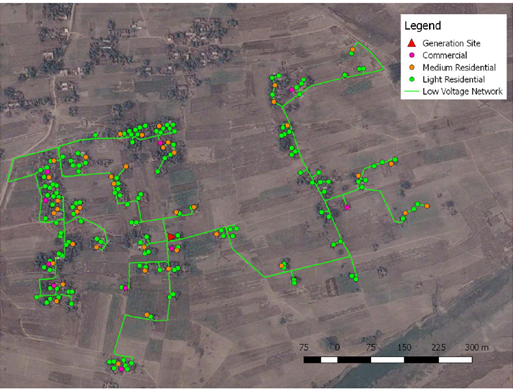
Source: Ciller, Pedro, and Sara Lumbreras. “Electricity for all: The contribution of large-scale planning tools to the energy-access problem.” Renewable and Sustainable Energy Reviews 120 (2020): 109624.