The Philippines has shown a strong reliance on coal as a major contributor to electricity generation in in the last few years as indicated in the figure below. As total power generation moves closer to 120 TWh, increases in almost every resource type is observed. Oil and hydro, however, appear to have experienced periods of decline.[1] Oil-based technologies had an output of 5,886 GWh in 2015 before settling on 3,752 GWh in 2019. Meanwhile, hydro resources used to generate 8,665 GWh before its 2019 output of 8,025 GWh.
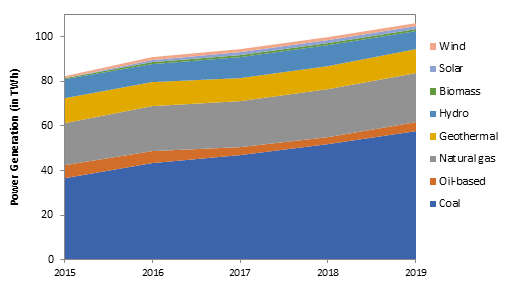
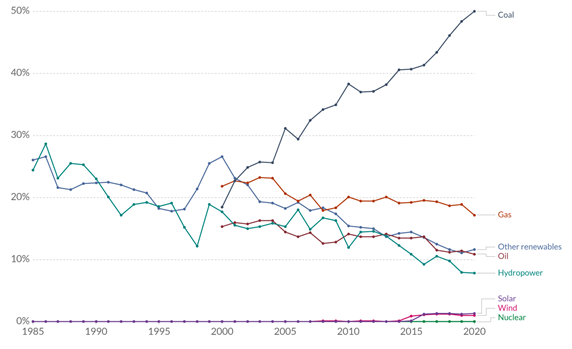
Source: OUR WORLD IN DATA, ELECTRICITY MIX, HTTP://OURWORLDINDATA.ORG/ENERGY/COUNTRY/PHILIPPINES
Chasing Renewable Energy Targets
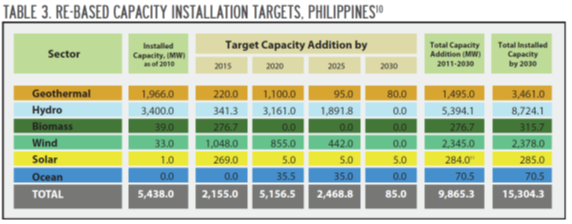
Despite recent mixed performances, renewable technologies need to step up in the coming years as it tries to achieve a number of industry goals set by the government. One of the primary goals is the 35% share of the total installed capacity by 2030 which RE technologies is behind at the moment with only 29.1% capacity as of 2020.
NATIONAL RENEWABLE ENERGY PROGRAM, HTTP://WWW.DOE.GOV.PH/NATIONAL-RENEWABLE-ENERGY-PROGRAM.
The other prime goal is for RE technologies to achieve a 15,304.3 MW total installed capacity by 2030 as mentioned in the National Renewable Energy Program 2011-2030. As of 2020, this number is halfway at 7,653 MW with 7,651 MW more to go. Figure 28 outlines capacity targets per RE technology within a timeframe that covers until 2030. DOE updates the renewable capacity target of at least 20,000 MW to more than 30,000 MW by 2040.[2] The program foresees an additional 20,000 MW capacity to add to the grid on top of existing RE capacity. Geothermal capacities are eyed to increase by 1,453 MW in addition to the existing 1,928 MW bringing the total geothermal capacity to 3,359 MW by 2040. Hydropower is expected to be reinforced by 13,440 MW by 2040. Biomass projects indicate new capacities of 1,305.7 MW. Wind capacity is expected to increase by 1,337.7 MW while solar is considered to have enough projects for it to reach the 11,070 MW target.[3]
[1] DOE, Key Energy Statistics 2019, 60.
[2] DOE, Philippine Energy Plan 2018-2040
[3] DOE, Philippine Energy Plan 2018-2040
]]>
The creation of the Total Electrification Master Plan under the umbrella of the TEP is meant to oversee electrification of unserved and underserved communities within the franchise areas of the distribution utilities (DU).
Two major forms of electrification programs have been identified by the TEP, namely: grid electrification and off-grid electrification. [1]

Source: INTERNATIONAL RENEWABLE ENERGY AGENCY; “HOUSEHOLD ELECTRIFICATION DEVELOPMENT PLAN 2013-2017”; ACCELERATING RENEWABLE MINI-GRID DEVELOPMENT: A STUDY ON THE PHILIPPINES
Nationwide Intensification of Household Electrification (NIHE) Program
Implemented from 2015 to 2017, the NIHE program was originally a three-year project aimed at intensifying household electrification. Under NIHE, DU’s are encouraged to adopt more pro-active and innovative marketing strategies to fast-track electrification of the remaining unelectrified households both in rural and urban areas of the country.[2] However, with the need to further expand the program, the DOE carried out a review and evaluation of its existing mechanism to further enhance and streamline the requirements. In the later part of 2017, the DOE issued the implementation guidelines that included the streamlined process in project approval, implementation and monitoring.[3]
Barangay Line Enhancement Program (BLEP)
Spearheaded by NEA, BLEP aims to rehabilitate barangays previously served by off-grid solutions but deemed unsustainable. To enhance the program, it will cover off-grid barangays that are already economically feasible for distribution line extension. NEA will assist in recovering the existing off-grid electrification facilities still owned by the government for reconfiguration and transfer to other far-flung areas that can be best served by off-grid solutions.
Sitio Electrification Program
The SEP is one of the government’s priority programs for economic development and poverty reduction by aiming for 100% sitio electrification. This program aims to energize an unlit sitio, purok, or zone which are defined as a territorial enclave that forms part of a barangay, the location of which may be distant from the center of the barangay itself, through providing funds for the construction of distribution lines and house wiring facilities to eligible households.
Missionary Electrification
While access to quality electricity is readily available to areas tied to the grid, the same cannot be said for marginalized communities in far flung and isolated areas that are not yet connected to the main grid. These off-grid areas are typically small islands and isolated grids (SIIG) and the EPIRA Law requires the government to intervene in securing reliable electricity to these places. Electricity supply to these areas is being provided mainly by the NPC through the Small Power Utilities Group (SPUG), privately-owned New Power Providers (NPP) for relatively large off-grid islands, and some QTP providers servicing far-flung and remote areas.[4]
International Partnerships
The European Union with assistance from the World Bank has lent its support to the Philippine government through the Access to Sustainable Energy Program which aims to promote sustainable energy for all as well as meet rural electrification targets using renewable energy. The program has funding support of around 66 million Euros to be used for the application of sustainable energy goals in meeting the growing energy needs of the country including providing greater energy access to the poor and marginalized sector.[5]
PV Mainstreaming
Solar Photovoltaic Mainstreaming (PVM) is a program by DOE that seeks to “mainstream” the provision of solar home systems as a utility service offering of EC’s and other regulated electricity suppliers. The PVM initiative targets households with no access to the grid and are not expected to be energized through either SEP, BLEP or NIHE within a few years.[6]
[1] DOE, Energy Plan, 146.
[2] DOE, 36th EPIRA Implementation Status Report, 90.
[3] DOE, Philippine Energy Plan 2018-2040, 149.
[4] DOE, Philippine Energy Plan 2018-2040, 110
[5] DOE, Philippine Energy Plan 2018-2040, 206.
[6] NEA, Memorandum on Solar PV Mainstreaming for Household Electrification, 1.
]]>
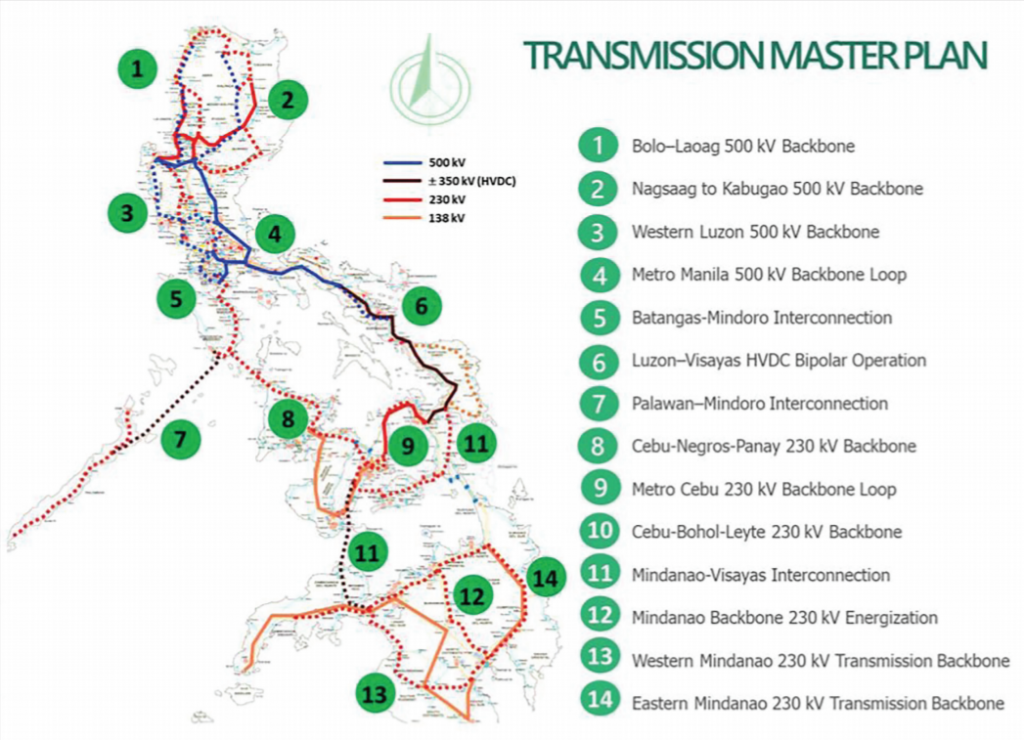
In 2017 to 2018, the National Grid Corporation of the Philippines (NGCP) focused on upgrading substation capacities and expanding transmission backbones which completed a total of 552.24 circuit-kilometers (ckt-km) of overhead transmission lines, installed additional 851 megavolt amperes of (MVA) substation capacities and 35 megavolt amperes reactive (MVAR) or reactive power for voltage improvement.[2]
In 2019, thirteen (13) main grid projects were completed and energized by the NGCP including the addition of 55 ckt-km of transmission lines, 3,200 MVA and 1,352.5 MVAR of substation capacity. Table 16 shows a total of 20,079 ckt-km and 36,436 MVA substation capacities are accounted for in the transmission assets being managed by NGCP.[3]
Source: ADB, PHILIPPINE ENERGY SECTOR ASSESSMENT, STRATEGY AND ROAD MAP
[1] ADB, Philippines Energy Sector Assessment, Strategy and Road Map, 17.
[2] DOE, Philippine Energy Plan 2018-2040, 117.
[3] DOE, 2019 Power Situation Report, 24.
]]>
- Generation of Electricity refers to the production of electricity by a generation company or a co-generation facility
- Transmission of Electricity refers to the conveyance of electricity through the high voltage backbone system
- Distribution of Electricity refers to the conveyance of electric power by a distribution utility through its distribution system
- Supply of Electricity means the sale of electricity by a party other than a generator or a distributor in the franchise area of a distribution utility using the wires of the distribution utility concerned
Under EPIRA, there are two ways electricity is provided to a household: grid and off-grid. A household is considered to be serviced through the grid if electricity access is provided through local connections from a main grid.
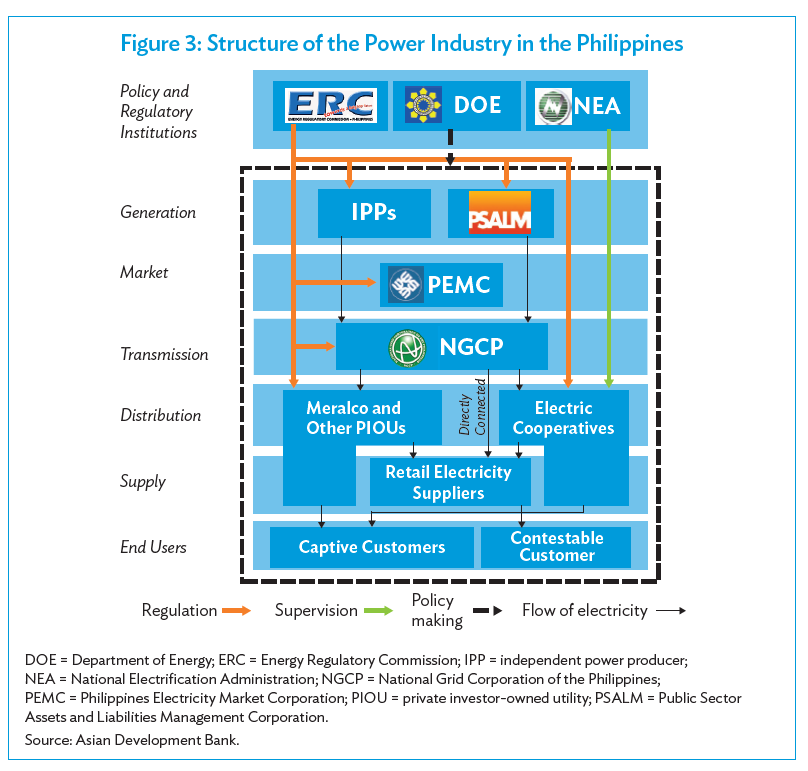
Figure: Structure of the Power Industry in the Philippines[1]
In the context of the Philippines, consumers located in larger islands are generally connected to a main grid system (i.e. Luzon Grid, Visayas Grid, Mindanao Grid), while those geographically unable to connect to the main grid make use of small islands and isolated grids (SIIGs) whose supply is provided by the NPC-Small Power Utilities Group (NPC-SPUG), privately-owned New Power Providers (NPPs) and Qualified Third Party (QTP) providers.[2]
[1] Asian Development Bank, “Philippines Energy Sector Assessment, Strategy, and Road Map”

[2] Philippine Energy Plan 2020
]]>