Deprecated: Return type of WP_Theme::offsetExists($offset) should either be compatible with ArrayAccess::offsetExists(mixed $offset): bool, or the #[\ReturnTypeWillChange] attribute should be used to temporarily suppress the notice in /home/u189388336/domains/solarsolutions.ph/public_html/portal/wp-includes/class-wp-theme.php on line 554

Deprecated: Return type of WP_Theme::offsetGet($offset) should either be compatible with ArrayAccess::offsetGet(mixed $offset): mixed, or the #[\ReturnTypeWillChange] attribute should be used to temporarily suppress the notice in /home/u189388336/domains/solarsolutions.ph/public_html/portal/wp-includes/class-wp-theme.php on line 595

Deprecated: Return type of WP_Theme::offsetSet($offset, $value) should either be compatible with ArrayAccess::offsetSet(mixed $offset, mixed $value): void, or the #[\ReturnTypeWillChange] attribute should be used to temporarily suppress the notice in /home/u189388336/domains/solarsolutions.ph/public_html/portal/wp-includes/class-wp-theme.php on line 535

Deprecated: Return type of WP_Theme::offsetUnset($offset) should either be compatible with ArrayAccess::offsetUnset(mixed $offset): void, or the #[\ReturnTypeWillChange] attribute should be used to temporarily suppress the notice in /home/u189388336/domains/solarsolutions.ph/public_html/portal/wp-includes/class-wp-theme.php on line 544

Deprecated: Return type of WP_REST_Request::offsetExists($offset) should either be compatible with ArrayAccess::offsetExists(mixed $offset): bool, or the #[\ReturnTypeWillChange] attribute should be used to temporarily suppress the notice in /home/u189388336/domains/solarsolutions.ph/public_html/portal/wp-includes/rest-api/class-wp-rest-request.php on line 960

Deprecated: Return type of WP_REST_Request::offsetGet($offset) should either be compatible with ArrayAccess::offsetGet(mixed $offset): mixed, or the #[\ReturnTypeWillChange] attribute should be used to temporarily suppress the notice in /home/u189388336/domains/solarsolutions.ph/public_html/portal/wp-includes/rest-api/class-wp-rest-request.php on line 980

Deprecated: Return type of WP_REST_Request::offsetSet($offset, $value) should either be compatible with ArrayAccess::offsetSet(mixed $offset, mixed $value): void, or the #[\ReturnTypeWillChange] attribute should be used to temporarily suppress the notice in /home/u189388336/domains/solarsolutions.ph/public_html/portal/wp-includes/rest-api/class-wp-rest-request.php on line 992

Deprecated: Return type of WP_REST_Request::offsetUnset($offset) should either be compatible with ArrayAccess::offsetUnset(mixed $offset): void, or the #[\ReturnTypeWillChange] attribute should be used to temporarily suppress the notice in /home/u189388336/domains/solarsolutions.ph/public_html/portal/wp-includes/rest-api/class-wp-rest-request.php on line 1003

Deprecated: Return type of WP_Block_List::current() should either be compatible with Iterator::current(): mixed, or the #[\ReturnTypeWillChange] attribute should be used to temporarily suppress the notice in /home/u189388336/domains/solarsolutions.ph/public_html/portal/wp-includes/class-wp-block-list.php on line 151

Deprecated: Return type of WP_Block_List::next() should either be compatible with Iterator::next(): void, or the #[\ReturnTypeWillChange] attribute should be used to temporarily suppress the notice in /home/u189388336/domains/solarsolutions.ph/public_html/portal/wp-includes/class-wp-block-list.php on line 175

Deprecated: Return type of WP_Block_List::key() should either be compatible with Iterator::key(): mixed, or the #[\ReturnTypeWillChange] attribute should be used to temporarily suppress the notice in /home/u189388336/domains/solarsolutions.ph/public_html/portal/wp-includes/class-wp-block-list.php on line 164

Deprecated: Return type of WP_Block_List::valid() should either be compatible with Iterator::valid(): bool, or the #[\ReturnTypeWillChange] attribute should be used to temporarily suppress the notice in /home/u189388336/domains/solarsolutions.ph/public_html/portal/wp-includes/class-wp-block-list.php on line 186

Deprecated: Return type of WP_Block_List::rewind() should either be compatible with Iterator::rewind(): void, or the #[\ReturnTypeWillChange] attribute should be used to temporarily suppress the notice in /home/u189388336/domains/solarsolutions.ph/public_html/portal/wp-includes/class-wp-block-list.php on line 138

Deprecated: Return type of WP_Block_List::offsetExists($index) should either be compatible with ArrayAccess::offsetExists(mixed $offset): bool, or the #[\ReturnTypeWillChange] attribute should be used to temporarily suppress the notice in /home/u189388336/domains/solarsolutions.ph/public_html/portal/wp-includes/class-wp-block-list.php on line 75

Deprecated: Return type of WP_Block_List::offsetGet($index) should either be compatible with ArrayAccess::offsetGet(mixed $offset): mixed, or the #[\ReturnTypeWillChange] attribute should be used to temporarily suppress the notice in /home/u189388336/domains/solarsolutions.ph/public_html/portal/wp-includes/class-wp-block-list.php on line 89

Deprecated: Return type of WP_Block_List::offsetSet($index, $value) should either be compatible with ArrayAccess::offsetSet(mixed $offset, mixed $value): void, or the #[\ReturnTypeWillChange] attribute should be used to temporarily suppress the notice in /home/u189388336/domains/solarsolutions.ph/public_html/portal/wp-includes/class-wp-block-list.php on line 110

Deprecated: Return type of WP_Block_List::offsetUnset($index) should either be compatible with ArrayAccess::offsetUnset(mixed $offset): void, or the #[\ReturnTypeWillChange] attribute should be used to temporarily suppress the notice in /home/u189388336/domains/solarsolutions.ph/public_html/portal/wp-includes/class-wp-block-list.php on line 127

Deprecated: Return type of WP_Block_List::count() should either be compatible with Countable::count(): int, or the #[\ReturnTypeWillChange] attribute should be used to temporarily suppress the notice in /home/u189388336/domains/solarsolutions.ph/public_html/portal/wp-includes/class-wp-block-list.php on line 199

Deprecated: Return type of Ai1wm_Recursive_Directory_Iterator::hasChildren($allow_links = true) should either be compatible with RecursiveDirectoryIterator::hasChildren(bool $allowLinks = false): bool, or the #[\ReturnTypeWillChange] attribute should be used to temporarily suppress the notice in /home/u189388336/domains/solarsolutions.ph/public_html/portal/wp-content/plugins/all-in-one-wp-migration/lib/vendor/servmask/iterator/class-ai1wm-recursive-directory-iterator.php on line 61

Deprecated: Return type of Ai1wm_Recursive_Directory_Iterator::rewind() should either be compatible with FilesystemIterator::rewind(): void, or the #[\ReturnTypeWillChange] attribute should be used to temporarily suppress the notice in /home/u189388336/domains/solarsolutions.ph/public_html/portal/wp-content/plugins/all-in-one-wp-migration/lib/vendor/servmask/iterator/class-ai1wm-recursive-directory-iterator.php on line 39

Deprecated: Return type of Ai1wm_Recursive_Directory_Iterator::next() should either be compatible with DirectoryIterator::next(): void, or the #[\ReturnTypeWillChange] attribute should be used to temporarily suppress the notice in /home/u189388336/domains/solarsolutions.ph/public_html/portal/wp-content/plugins/all-in-one-wp-migration/lib/vendor/servmask/iterator/class-ai1wm-recursive-directory-iterator.php on line 46

Deprecated: Return type of Ai1wm_Recursive_Extension_Filter::getChildren() should either be compatible with RecursiveFilterIterator::getChildren(): ?RecursiveFilterIterator, or the #[\ReturnTypeWillChange] attribute should be used to temporarily suppress the notice in /home/u189388336/domains/solarsolutions.ph/public_html/portal/wp-content/plugins/all-in-one-wp-migration/lib/vendor/servmask/filter/class-ai1wm-recursive-extension-filter.php on line 51

Deprecated: Return type of Ai1wm_Recursive_Extension_Filter::accept() should either be compatible with FilterIterator::accept(): bool, or the #[\ReturnTypeWillChange] attribute should be used to temporarily suppress the notice in /home/u189388336/domains/solarsolutions.ph/public_html/portal/wp-content/plugins/all-in-one-wp-migration/lib/vendor/servmask/filter/class-ai1wm-recursive-extension-filter.php on line 41

Deprecated: Return type of Ai1wm_Recursive_Exclude_Filter::getChildren() should either be compatible with RecursiveFilterIterator::getChildren(): ?RecursiveFilterIterator, or the #[\ReturnTypeWillChange] attribute should be used to temporarily suppress the notice in /home/u189388336/domains/solarsolutions.ph/public_html/portal/wp-content/plugins/all-in-one-wp-migration/lib/vendor/servmask/filter/class-ai1wm-recursive-exclude-filter.php on line 67

Deprecated: Return type of Ai1wm_Recursive_Exclude_Filter::accept() should either be compatible with FilterIterator::accept(): bool, or the #[\ReturnTypeWillChange] attribute should be used to temporarily suppress the notice in /home/u189388336/domains/solarsolutions.ph/public_html/portal/wp-content/plugins/all-in-one-wp-migration/lib/vendor/servmask/filter/class-ai1wm-recursive-exclude-filter.php on line 43

Deprecated: version_compare(): Passing null to parameter #2 ($version2) of type string is deprecated in /home/u189388336/domains/solarsolutions.ph/public_html/portal/wp-content/plugins/elementor/core/upgrade/manager.php on line 62

Deprecated: ltrim(): Passing null to parameter #1 ($string) of type string is deprecated in /home/u189388336/domains/solarsolutions.ph/public_html/portal/wp-includes/wp-db.php on line 3030

Warning: Cannot modify header information - headers already sent by (output started at /home/u189388336/domains/solarsolutions.ph/public_html/portal/wp-includes/class-wp-block-list.php:14) in /home/u189388336/domains/solarsolutions.ph/public_html/portal/wp-includes/feed-rss2.php on line 8
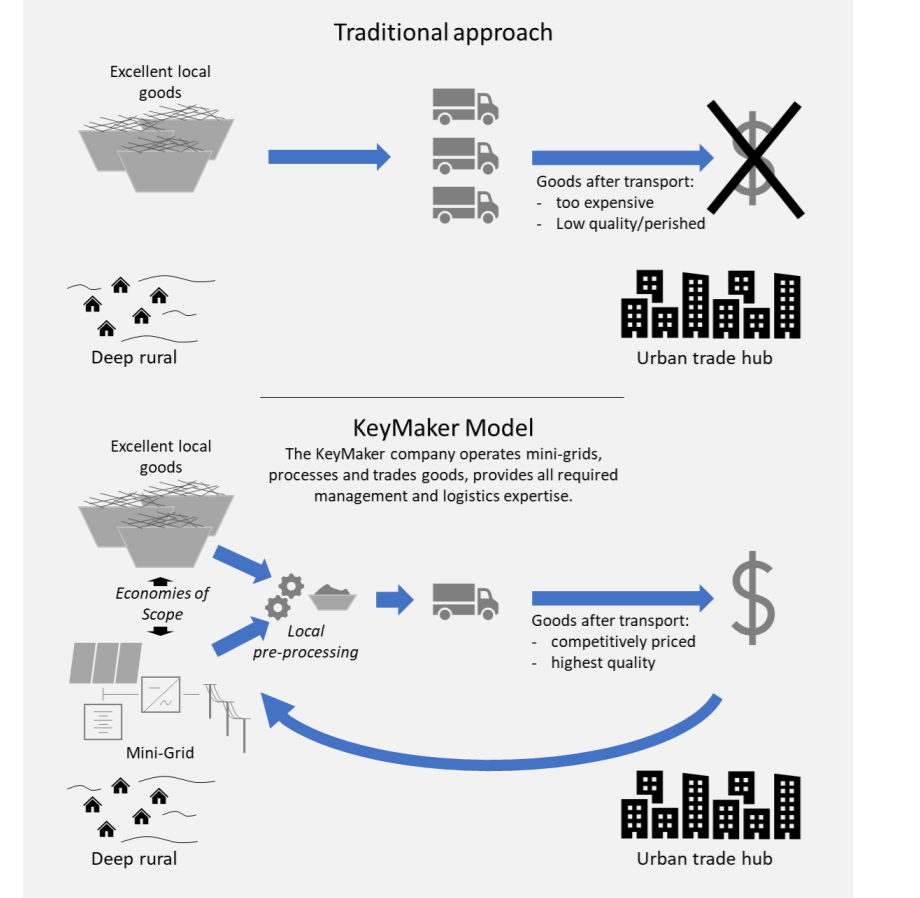
FRAMEWORKS – Energy Portal https://solarsolutions.ph/portal Data, Analytics, Mapping Resource Thu, 09 Sep 2021 04:58:28 +0000 en-US hourly 1 https://wordpress.org/?v=5.8.13 The KeyMaker Model https://solarsolutions.ph/portal/the-keymaker-model/ Thu, 09 Sep 2021 04:58:27 +0000 https://solarsolutions.ph/portal/?p=531 The principle behind the KeyMaker model is based on having the mini-grid operator to take advantage of an established and well managed network providing a stable supply of electricity to qualitatively improve a strategic value chain in the local community, often on the agriculture processing and trading sectors. The electricity supplier in turn becomes an agro-product processor. As a result, the farmers’ produce is now locally processed and well-preserved while marketed beyond the local community to reach regional, national or international markets, freeing the community from the economic constraint implied by its remote location.[1]

The Mechanics of the KeyMaker Model
Source: INENSUS GMBH; “ECONOMIC INCLUSION OF DEEP RURAL AREAS USING THE KEYMAKER MODEL”; KEYMAKER MODEL FUNDAMENTALS


[1] Andrea Cabanero et al., Mini-Grids for the Sustainable Electrification of Rural Areas in Sub-Saharan Africa: Assessing the Potential of KeyMaker Models, 2.
]]>
Development Frameworks and Implementation Strategies https://solarsolutions.ph/portal/development-frameworks-and-implementation-strategies/ Thu, 09 Sep 2021 04:54:16 +0000 https://solarsolutions.ph/portal/?p=523
Framework/ModelDescriptionTargetFeatures
UNGC Sustainable Energy Framework for Business ActionHeavily reliant on the private sector to jump start a number of activities that will lead to achieving sustainability targets, and must also be open to partnerships and collaboration with the government for greater impactBusinesses and private developers (main), government and policy makers (secondary)Encourages social investments and philanthropy which can open up opportunities with poorer communities and NGO’s causing further significant sustainability impact
SEAPUsed to identify cost-effective and sustainable resource and technology options for providing universal access to basic energy services including assessing cleaner-energy service optionsEnergy access planners (main), policy makers (secondary)Mainly benefits energy poor households but its socially inclusive nature promotes all types of households  
DREIAims to reduce the financing costs of renewable energy investments in order to attract capitalPolicy makers (main), private investors (secondary)Specifically designed for utility-scale RE before later expanding to solar mini-grids
RISEAssesses policies and regulations on universal access to clean and modern energy in order to attract investmentPolicy makers (main), private investors (secondary)Data from 138 countries has resulted in a comprehensive library of policies and regulations on sustainable energy including global, regional and national best practices
MTFMonitor and evaluates energy access by following a multidimensional approach made possible by measuring energy access using a multi-tiered spectrumMultiple stakeholdersConsiders all other forms of energy access commonly ignored; technology and fuel neutral
Summary of Frameworks and Implementation Tools
Source: UNGC, ADB, UNDP, ESMAP
]]>
Frameworks Supporting Frameworks https://solarsolutions.ph/portal/frameworks-supporting-frameworks/ Thu, 09 Sep 2021 04:52:25 +0000 https://solarsolutions.ph/portal/?p=514 The lack of a universal definition of access to energy has led to the emergence of several approaches attempting to measure access to energy using a variety of indicators. Wide-ranging approaches have been developed by various researchers and practitioners to measure different aspects of energy access that will help define strategies toward a more sustainable energy future.[1]

Certain approaches exist as frameworks but are suited better as supporting frameworks for particular scenarios. These frameworks are not as flexible as the ones that have already been discussed but are in fact tied to only one type of purpose or application.


Regulatory Indicators for Sustainable Energy

One model that utilizes indicators is the Regulatory Indicators for Sustainable Energy (RISE) model. It is a set of indicators comparing the policy and regulatory frameworks to support the achievement of sustainable energy goals on universal access to clean and modern energy. It is a tool for policy makers to compare national policy frameworks for sustainable energy as they seek to attract investment from the private sector.
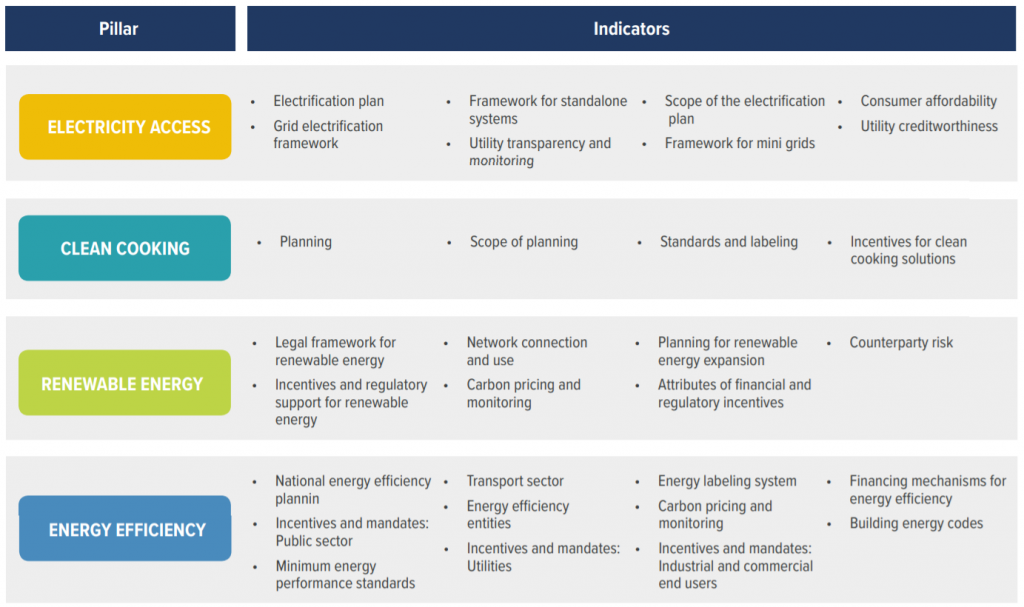
The RISE Framework’s Pillars and Indicators
Source: WORLD BANK/ENERGY SECTOR MANAGEMENT ASSISTANCE PROGRAM; RISE 2020: SUSTAINING THE MOMENTUM

The Multi-Tier Framework

The Multi-Tier Framework (MTF) for measuring energy access was first introduced by the World Bank’s Energy Sector Management Assistance Program (ESMAP) in the 2013 Global Tracking Framework (GTF) report together with other organisations and programs.

MTF identifies three areas it is applicable to: one for assessing household access to energy, another for assessing the access to energy for productive engagement and lastly, a category for assessing the access to energy for community facilities. Each of these are further divided into energy applications specific to their categories. For household energy access, this is further divided into access to electricity, cooking solutions and space heating.
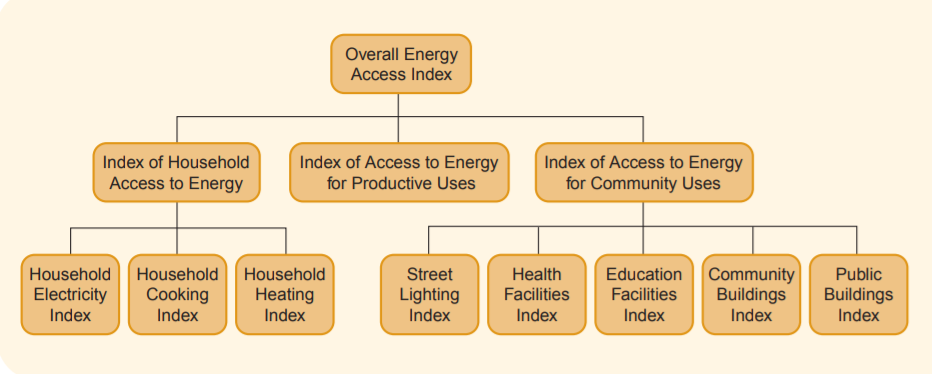
Hierarchy of Energy Access Indices
Source: ESMAP, BEYOND CONNECTIONS: ENERGY ACCESS REFINED
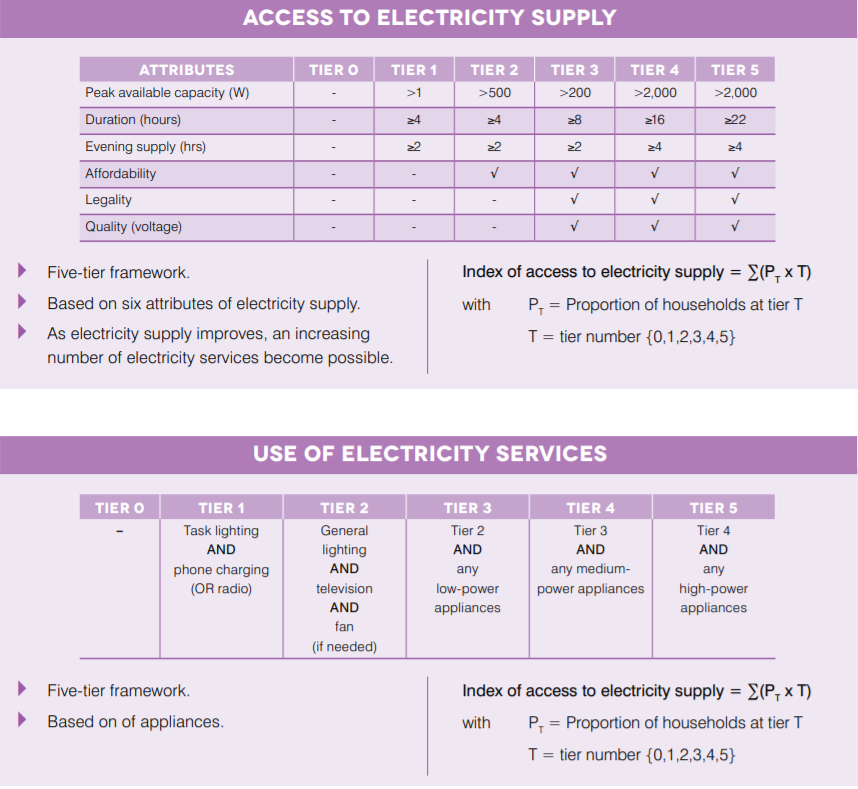
Proposed matrix for multi-tier measurement of household electricity access
Source: ESMAP: Global Tracking Framework

[1] Energy Sector Management Assistance Program, Beyond Connections: Energy Access Redefined, 26-28.
]]>
Energy Access Underlined by Development Frameworks https://solarsolutions.ph/portal/energy-access-underlined-by-development-frameworks/ Thu, 09 Sep 2021 03:10:29 +0000 https://solarsolutions.ph/portal/?p=506 Access to energy is essential in meeting basic needs and attaining an improved quality of life for individuals. It has been defined as the provision of adequate amounts of high-quality and reliable modern energy supplies when needed and as the ability of individuals to purchase such supplies in the amounts deemed necessary for their daily use.[1] It is instrumental in reducing poverty, crucial to a country’s economy and it ensures sustainable development therefore access to energy must be available to all.

Using these prevalent concepts, frameworks which put prime on sustainability are prioritized and will be utilized to serve as guides for organizing systems into regulated structures that developers can use to build programs such as those for expanding access to household electricity. Frameworks such as the UN Global Compact for Sustainable Energy, Sustainable Energy Access Planning, Derisking Renewable Energy Investment, Regulatory Indicators for Sustainable Energy and the Multi-Tier Framework are fundamental to the scope of this report.


UN Global Compact for Sustainable Energy Framework

The United Nations (UN) with its partners developed the UN Global Compact for Sustainable Energy framework which identifies and shapes the role of businesses in achieving sustainability targets centered on energy development by 2030. The 2012 UN General Assembly outlined these targets in the “Sustainability For All (SE4ALL)” initiative, and they are universal access to modern energy services, improving energy efficiency and increasing the utilization of renewable resources.
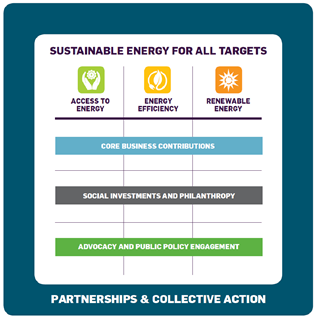
Framework for Business Action
Source: UN Global Compact

Sustainable Energy Access Planning Framework

Developed by the Asian Development Bank (ADB) through their Energy for All Initiative which seeks to maximize access to energy by providing an improved framework and assessment basis to shape responses and build better solutions, the sustainable energy access planning (SEAP) framework has features that are distinct from traditional electricity and energy planning frameworks. The identification of cost-effective and sustainable resource and technology options for providing universal access to basic energy services as well as the assessment of the affordability of cleaner-energy service options to energy-poor households are among its main objectives.

This framework focuses on social inclusiveness and takes into account the ability of even the poorest households in gaining access to electricity and other cleaner forms of energy to meet their basic energy needs for lighting, cooking and heating. It also considers the acceptable minimum level of basic energy services to the energy poor and uses tools to assess the energy demand of non-poor households.
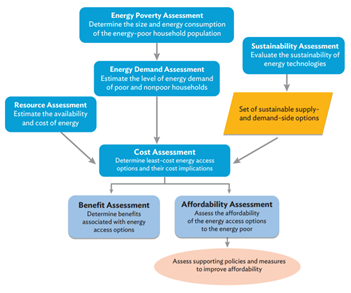
Sustainable Energy Access Planning Framework
Source: ADB, Sustainable Energy Access Planning: A Framework

Derisking Renewable Energy Investment Framework

The Derisking Renewable Energy Investment (DREI) framework aims to assist policymakers in developing countries to cost-effectively promote investment in renewable energy by utilizing publicly-available methodologies, financial tools, models and resources.

The DREI framework was launched in 2013 by the United Nations Development Programme (UNDP) and was originally focused on utility-scale renewable energy. Recently it has taken on an energy access expansive nature by extending to on-grid rooftop PV, off-grid solar home systems and off-grid solar mini-grids. The overall aim of the framework is to cost-effectively achieve a risk-return profile that encourages private sector investment.[2]
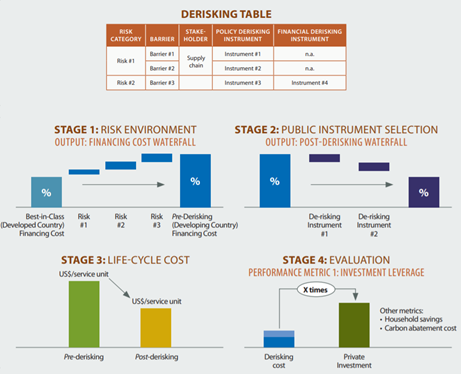

Overview of the DREI framework to support policymakers to promote off-grid renewable energy investments
Source: UNDP, Derisking Renewable Energy

[1] G20 2016 China, Enhancing Energy Access in Asia and the Pacific: Key Challenges and G20 Voluntary Collaboration Action Plan, http://www.g20.utoronto.ca/2016/enhancing-energy-access-in-asia-and-pacific.pdf.
[2] UNDP, Derisking Renewable Energy Investment: Off-Grid Electrification, 27.
]]>