Deprecated: Return type of WP_Theme::offsetExists($offset) should either be compatible with ArrayAccess::offsetExists(mixed $offset): bool, or the #[\ReturnTypeWillChange] attribute should be used to temporarily suppress the notice in /home/u189388336/domains/solarsolutions.ph/public_html/portal/wp-includes/class-wp-theme.php on line 554

Deprecated: Return type of WP_Theme::offsetGet($offset) should either be compatible with ArrayAccess::offsetGet(mixed $offset): mixed, or the #[\ReturnTypeWillChange] attribute should be used to temporarily suppress the notice in /home/u189388336/domains/solarsolutions.ph/public_html/portal/wp-includes/class-wp-theme.php on line 595

Deprecated: Return type of WP_Theme::offsetSet($offset, $value) should either be compatible with ArrayAccess::offsetSet(mixed $offset, mixed $value): void, or the #[\ReturnTypeWillChange] attribute should be used to temporarily suppress the notice in /home/u189388336/domains/solarsolutions.ph/public_html/portal/wp-includes/class-wp-theme.php on line 535

Deprecated: Return type of WP_Theme::offsetUnset($offset) should either be compatible with ArrayAccess::offsetUnset(mixed $offset): void, or the #[\ReturnTypeWillChange] attribute should be used to temporarily suppress the notice in /home/u189388336/domains/solarsolutions.ph/public_html/portal/wp-includes/class-wp-theme.php on line 544

Deprecated: Return type of WP_REST_Request::offsetExists($offset) should either be compatible with ArrayAccess::offsetExists(mixed $offset): bool, or the #[\ReturnTypeWillChange] attribute should be used to temporarily suppress the notice in /home/u189388336/domains/solarsolutions.ph/public_html/portal/wp-includes/rest-api/class-wp-rest-request.php on line 960

Deprecated: Return type of WP_REST_Request::offsetGet($offset) should either be compatible with ArrayAccess::offsetGet(mixed $offset): mixed, or the #[\ReturnTypeWillChange] attribute should be used to temporarily suppress the notice in /home/u189388336/domains/solarsolutions.ph/public_html/portal/wp-includes/rest-api/class-wp-rest-request.php on line 980

Deprecated: Return type of WP_REST_Request::offsetSet($offset, $value) should either be compatible with ArrayAccess::offsetSet(mixed $offset, mixed $value): void, or the #[\ReturnTypeWillChange] attribute should be used to temporarily suppress the notice in /home/u189388336/domains/solarsolutions.ph/public_html/portal/wp-includes/rest-api/class-wp-rest-request.php on line 992

Deprecated: Return type of WP_REST_Request::offsetUnset($offset) should either be compatible with ArrayAccess::offsetUnset(mixed $offset): void, or the #[\ReturnTypeWillChange] attribute should be used to temporarily suppress the notice in /home/u189388336/domains/solarsolutions.ph/public_html/portal/wp-includes/rest-api/class-wp-rest-request.php on line 1003

Deprecated: Return type of WP_Block_List::current() should either be compatible with Iterator::current(): mixed, or the #[\ReturnTypeWillChange] attribute should be used to temporarily suppress the notice in /home/u189388336/domains/solarsolutions.ph/public_html/portal/wp-includes/class-wp-block-list.php on line 151

Deprecated: Return type of WP_Block_List::next() should either be compatible with Iterator::next(): void, or the #[\ReturnTypeWillChange] attribute should be used to temporarily suppress the notice in /home/u189388336/domains/solarsolutions.ph/public_html/portal/wp-includes/class-wp-block-list.php on line 175

Deprecated: Return type of WP_Block_List::key() should either be compatible with Iterator::key(): mixed, or the #[\ReturnTypeWillChange] attribute should be used to temporarily suppress the notice in /home/u189388336/domains/solarsolutions.ph/public_html/portal/wp-includes/class-wp-block-list.php on line 164

Deprecated: Return type of WP_Block_List::valid() should either be compatible with Iterator::valid(): bool, or the #[\ReturnTypeWillChange] attribute should be used to temporarily suppress the notice in /home/u189388336/domains/solarsolutions.ph/public_html/portal/wp-includes/class-wp-block-list.php on line 186

Deprecated: Return type of WP_Block_List::rewind() should either be compatible with Iterator::rewind(): void, or the #[\ReturnTypeWillChange] attribute should be used to temporarily suppress the notice in /home/u189388336/domains/solarsolutions.ph/public_html/portal/wp-includes/class-wp-block-list.php on line 138

Deprecated: Return type of WP_Block_List::offsetExists($index) should either be compatible with ArrayAccess::offsetExists(mixed $offset): bool, or the #[\ReturnTypeWillChange] attribute should be used to temporarily suppress the notice in /home/u189388336/domains/solarsolutions.ph/public_html/portal/wp-includes/class-wp-block-list.php on line 75

Deprecated: Return type of WP_Block_List::offsetGet($index) should either be compatible with ArrayAccess::offsetGet(mixed $offset): mixed, or the #[\ReturnTypeWillChange] attribute should be used to temporarily suppress the notice in /home/u189388336/domains/solarsolutions.ph/public_html/portal/wp-includes/class-wp-block-list.php on line 89

Deprecated: Return type of WP_Block_List::offsetSet($index, $value) should either be compatible with ArrayAccess::offsetSet(mixed $offset, mixed $value): void, or the #[\ReturnTypeWillChange] attribute should be used to temporarily suppress the notice in /home/u189388336/domains/solarsolutions.ph/public_html/portal/wp-includes/class-wp-block-list.php on line 110

Deprecated: Return type of WP_Block_List::offsetUnset($index) should either be compatible with ArrayAccess::offsetUnset(mixed $offset): void, or the #[\ReturnTypeWillChange] attribute should be used to temporarily suppress the notice in /home/u189388336/domains/solarsolutions.ph/public_html/portal/wp-includes/class-wp-block-list.php on line 127

Deprecated: Return type of WP_Block_List::count() should either be compatible with Countable::count(): int, or the #[\ReturnTypeWillChange] attribute should be used to temporarily suppress the notice in /home/u189388336/domains/solarsolutions.ph/public_html/portal/wp-includes/class-wp-block-list.php on line 199

Deprecated: Return type of Ai1wm_Recursive_Directory_Iterator::hasChildren($allow_links = true) should either be compatible with RecursiveDirectoryIterator::hasChildren(bool $allowLinks = false): bool, or the #[\ReturnTypeWillChange] attribute should be used to temporarily suppress the notice in /home/u189388336/domains/solarsolutions.ph/public_html/portal/wp-content/plugins/all-in-one-wp-migration/lib/vendor/servmask/iterator/class-ai1wm-recursive-directory-iterator.php on line 61

Deprecated: Return type of Ai1wm_Recursive_Directory_Iterator::rewind() should either be compatible with FilesystemIterator::rewind(): void, or the #[\ReturnTypeWillChange] attribute should be used to temporarily suppress the notice in /home/u189388336/domains/solarsolutions.ph/public_html/portal/wp-content/plugins/all-in-one-wp-migration/lib/vendor/servmask/iterator/class-ai1wm-recursive-directory-iterator.php on line 39

Deprecated: Return type of Ai1wm_Recursive_Directory_Iterator::next() should either be compatible with DirectoryIterator::next(): void, or the #[\ReturnTypeWillChange] attribute should be used to temporarily suppress the notice in /home/u189388336/domains/solarsolutions.ph/public_html/portal/wp-content/plugins/all-in-one-wp-migration/lib/vendor/servmask/iterator/class-ai1wm-recursive-directory-iterator.php on line 46

Deprecated: Return type of Ai1wm_Recursive_Extension_Filter::getChildren() should either be compatible with RecursiveFilterIterator::getChildren(): ?RecursiveFilterIterator, or the #[\ReturnTypeWillChange] attribute should be used to temporarily suppress the notice in /home/u189388336/domains/solarsolutions.ph/public_html/portal/wp-content/plugins/all-in-one-wp-migration/lib/vendor/servmask/filter/class-ai1wm-recursive-extension-filter.php on line 51

Deprecated: Return type of Ai1wm_Recursive_Extension_Filter::accept() should either be compatible with FilterIterator::accept(): bool, or the #[\ReturnTypeWillChange] attribute should be used to temporarily suppress the notice in /home/u189388336/domains/solarsolutions.ph/public_html/portal/wp-content/plugins/all-in-one-wp-migration/lib/vendor/servmask/filter/class-ai1wm-recursive-extension-filter.php on line 41

Deprecated: Return type of Ai1wm_Recursive_Exclude_Filter::getChildren() should either be compatible with RecursiveFilterIterator::getChildren(): ?RecursiveFilterIterator, or the #[\ReturnTypeWillChange] attribute should be used to temporarily suppress the notice in /home/u189388336/domains/solarsolutions.ph/public_html/portal/wp-content/plugins/all-in-one-wp-migration/lib/vendor/servmask/filter/class-ai1wm-recursive-exclude-filter.php on line 67

Deprecated: Return type of Ai1wm_Recursive_Exclude_Filter::accept() should either be compatible with FilterIterator::accept(): bool, or the #[\ReturnTypeWillChange] attribute should be used to temporarily suppress the notice in /home/u189388336/domains/solarsolutions.ph/public_html/portal/wp-content/plugins/all-in-one-wp-migration/lib/vendor/servmask/filter/class-ai1wm-recursive-exclude-filter.php on line 43

Deprecated: version_compare(): Passing null to parameter #2 ($version2) of type string is deprecated in /home/u189388336/domains/solarsolutions.ph/public_html/portal/wp-content/plugins/elementor/core/upgrade/manager.php on line 62

Deprecated: ltrim(): Passing null to parameter #1 ($string) of type string is deprecated in /home/u189388336/domains/solarsolutions.ph/public_html/portal/wp-includes/wp-db.php on line 3030

Warning: Cannot modify header information - headers already sent by (output started at /home/u189388336/domains/solarsolutions.ph/public_html/portal/wp-includes/class-wp-block-list.php:14) in /home/u189388336/domains/solarsolutions.ph/public_html/portal/wp-includes/feed-rss2.php on line 8
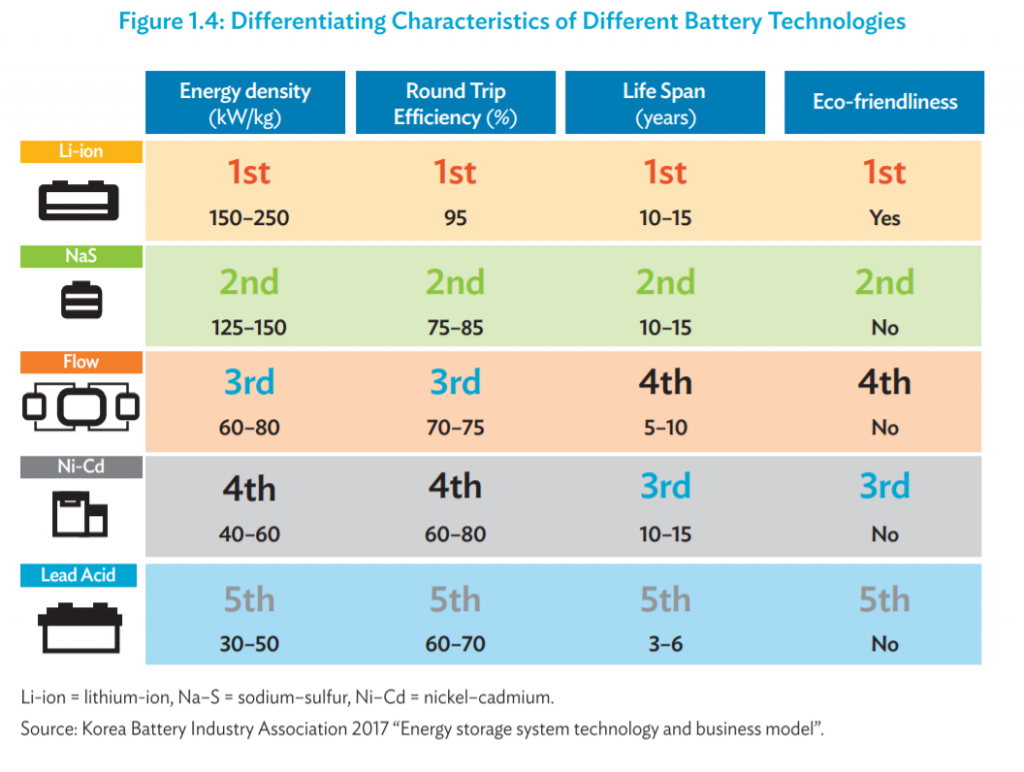
ENERGY SOURCES – Energy Portal https://solarsolutions.ph/portal Data, Analytics, Mapping Resource Fri, 10 Sep 2021 08:03:08 +0000 en-US hourly 1 https://wordpress.org/?v=5.8.13 Energy Storage https://solarsolutions.ph/portal/energy-storage/ Fri, 10 Sep 2021 08:03:06 +0000 https://solarsolutions.ph/portal/?p=567 Within battery energy storage systems for grid applications, Lithium-ion (Li-ion) technology is receiving the most attention and investment for grid reliability and stabilization in terms of RE capture, load leveling, and avoidance of brown-outs and black-outs in critical applications.[1] Li-ion chemistries also have the highest energy density and is considered one of the safest as shown in Figure 49. Other battery chemistry types include Lead-Acid (PbA) which is widely used in vehicles and other applications requiring high load current, Nickel-Cadmium (Ni-Cd) which is widely used for small battery-operated devices requiring an even power discharge, Sodium-Sulfur (Na-S) which is a type of molten metal battery primarily used for large-scale non-mobile applications, and the Redox Flow Battery (RFB) which has a long service life free of combustible materials despite having a complex means of operation.[2]

Differentiating characteristics of different battery technologies
Source: ASIAN DEVELOPMENT BANK; “STORAGE TYPES”; HANDBOOK ON BATTERY ENERGY STORAGE SYSTEM

[1] Ibrahim Dincer et al., Comprehensive Energy Systems, 656.
[2] ADB, Handbook on Battery Energy Storage System, 9-14.

]]>
Nuclear Energy https://solarsolutions.ph/portal/nuclear-energy/ Fri, 10 Sep 2021 07:39:29 +0000 https://solarsolutions.ph/portal/?p=559 The 1970’s oil crisis prompted government then under the Marcos administration to look for an alternative energy source which led to the construction of the Bataan nuclear power plant (BNPP).[1] However, the ready-to-operate[2] 2 billion USD facility was closed down shortly after Marcos was removed from power and also because of fears raised by the Chernobyl disaster[3]. To date, the BNPP remains unused, its fuel rods sold and shipped abroad yet maintenance by the NPC continued.[4] A renewed interest led to study groups from the IAEA and Korea Electric Power Corporation (KEPCO) to inspect and conduct feasibility evaluations of reviving the Philippine nuclear program. In 2016, the government established the Philippine Nuclear Energy Program  Implementing Organization (NEPIO) as one of the recommendations by the IAEA[5] then four years later, Executive Order 116 was issued directing a study for the adoption of a national position on a nuclear energy program.[6]

Potential sites were identified with the requirement of being located near the sea in order to provide abundant cooling water.[7] Figure 46 shows the twelve proposed sites for nuclear power plants which are accessible by land transportation and are within reasonable distance of transmission lines.
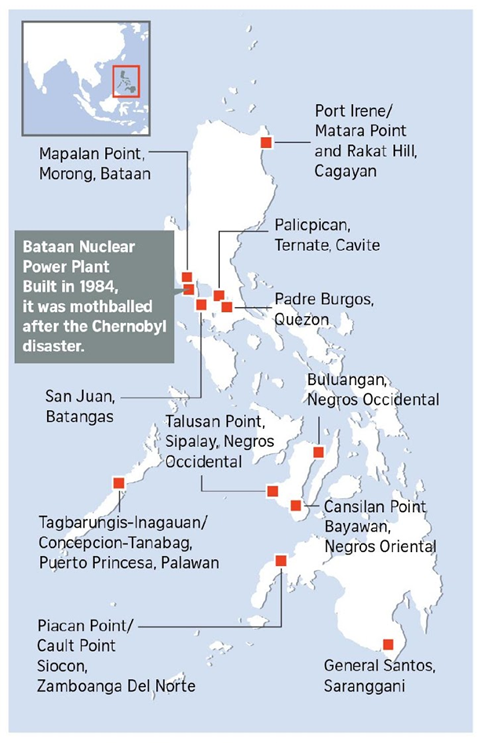
Candidate sites for nuclear power plants
Source: THE STRAITS TIMES; “IN POWER HUNGRY PHILIPPINES, SOME ADVOCATE A NUCLEAR REVIVAL”; WWW.STRAITSTIMES.COM/ASIA/SE-ASIA/IN-POWER-HUNGRY-PHILIPPINES-SOME-ADVOCATE-A-NUCLEAR-REVIVAL

[1] International Atomic Energy Agency, Country Nuclear Power Profiles: The Philippines 
[2] Josef Yap, Revisiting the Nuclear Option in the Philippines, 4.
[3] IAEA, Country Nuclear, 12.
[4] Arangkada Philippines and USAID, A Policy Brief on the Philippine Power Sector, 23.
[5] DOE, Philippine Energy Plan 2018-2040, 185.
[6] Josef Yap, Revisiting the Nuclear Option in the Philippines, 1.
[7] International Atomic Energy Agency, Country Nuclear Power Profiles: The Philippines 2015, 18. 2015, 12.
]]>
Renewable Energy https://solarsolutions.ph/portal/renewable-energy/ Fri, 10 Sep 2021 06:14:38 +0000 https://solarsolutions.ph/portal/?p=546 Biomass and Biofuels

Biomass is an organic, renewable energy, and it can exist in petrified living species. It can be converted into solid, liquid, and gaseous fuels. Biomass originates from the photosynthesis process using solar energy and comprises all plant life, the succeeding food chain, and all biological waste. Its resources exist in a huge diversity of wood forms, crop forms, and waste forms. The energy that can be harnessed from biomass resources through thermochemical, biochemical or physico-chemical processes can be used for heating applications, transportation and electricity.[1]

The Philippines produces a large amount of agricultural residues annually from farm land amounting to 14 million hectares.[2] These areas are highlighted in Figure 40. Rice husk and straw take up most of the residue, while the rest includes coconut husk and shell, corn cob and sugarcane bagasse. Forest residue, municipal solid wastes and animal manure from the husbandry industry are also part of the biomass feedstock. About 4,450 megawatts of net available capacity for power generation can be obtained from different types of biomass feedstock.

 Accredited Biofuel Facilities (as of 2018) 2018 (Mlpy) 2019 (Mlpy) 
 # of ProjectsCapacity (Mlpy)ProductionSalesProductionSales
Biodiesel11574.9219.98205.24241.5217.52
Bioethanol12380.5296.54303.73346.14355.55
Biofuels Production
Source: DOE. “RENEWABLE ENERGY.” PHILIPPINE ENERGY PLAN 2018-2040

Geothermal

The Philippines ranks third among the top geothermal power producers in the world based on installed capacity as of 2020, with 1,918 megawatts, behind the United States’ 3,676 megawatts and Indonesia’s 2,133 megawatts.[3] Situated along the Pacific Ring of Fire which is an area of high volcanic activity, it comes as no surprise that the Philippines has significant geothermal resources. The Philippine island arc is a tectonically active region, which was formed from the accretion and amalgamation of geologic terranes of various origins. The island arc is sandwiched between two oppositely dipping trench systems. This complex tectonic setting resulted in numerous active volcanoes, some of which are closely associated with geothermal steam fields.[4]
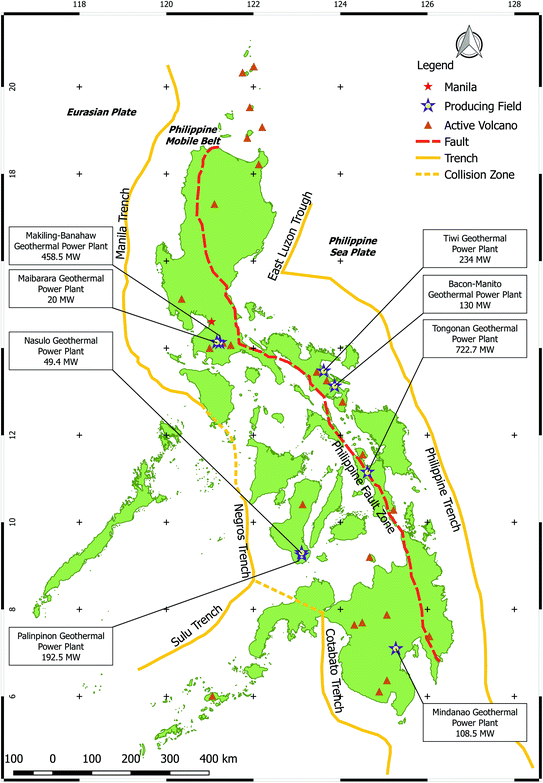
Philippine Geological Map and Installed Geothermal Capacity as of 2016
Source: RATIO ET AL; “THE PHILIPPINE EXPERIENCE IN GEOTHERMAL ENERGY DEVELOPMENT”; GEOTHERMAL ENERGY AND SOCIETY

Solar

Solar PV power is one of the fastest-growing energy resources in the world and is the third most generated renewable energy technology in the world.[5] Asia dominated the global solar market in 2018 with over half of the world’s addition of solar capacity from an installed capacity reaching 280 gigawatts by the end of 2018 which was dominated by China with 175 gigawatts.[6] Solar is projected to become a major global resource supplying 25% of total electricity demand by 2050.

The Philippines is located near the equator, making it an excellent candidate as a viable resource for solar energy. Updated resource potential data show that the Philippine annual average solar resource is fairly good at 5.1 kilowatt-hours (kWh) per meter squared (m2) per day. The highest solar irradiance occurs in April at 6.1 kWh/m2 per day throughout the country and is at its most intense in the northwestern part of Luzon as shown in Figure 42. Areas in the southern portion of Mindanao are also shown to have fairly good solar potential. The data show the resource distributed fairly evenly across the country, varying by 10% to 20% in any given month. This qualifies both northern and southern parts of the country for solar power generation. However, when factoring in seasonal variation between the wet months of May to October and dry months of November to May, solar irradiance changes substantially by 30% to 50% due to cloud coverage.[7]
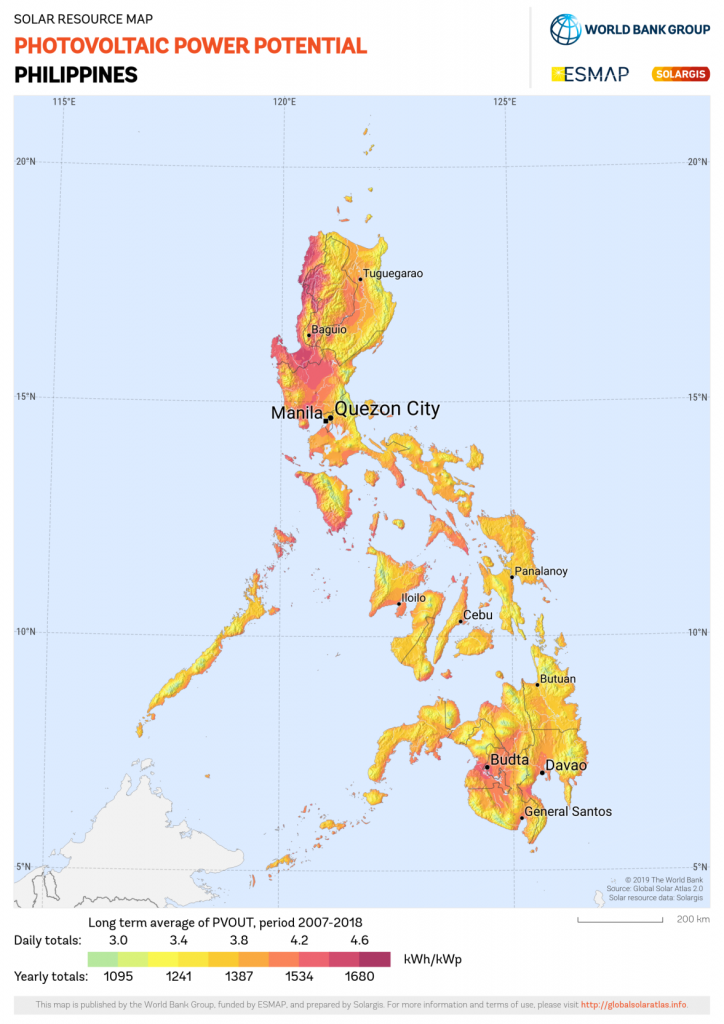
Photovoltaic Power Potential in the Philippines
Source: SOLARGIS; “SOLAR RESOURCE MAPS OF PHILIPPINES”; SOLARGIS.COM; WWW.SOLARGIS.COM/MAPS-AND-GIS-DATA/DOWNLOAD/PHILIPPINES

Wind

Recent data reveals that the Philippines has fairly good wind energy potential as shown below. The greatest wind resources are found mostly in Luzon’s northern and central areas including the country’s northernmost points like Batanes with good promise also being shown by areas in the Visayas. 11,055 km2 of windy territory has been identified as “good to excellent” wind resources. The wind speeds at these sites are 6.4 to 10.1 meters per second (m/s) and wind power density values are 300 to 1,250 watts/m2 (W/m2) (40 m hub height). This makes them theoretically suitable for grid-connected electricity generation. Using conservative assumptions of about 7 MW/km2, these areas could support more than 76,000 MW of potential installed capacity, providing more than 195 billion kWh per year.[8]
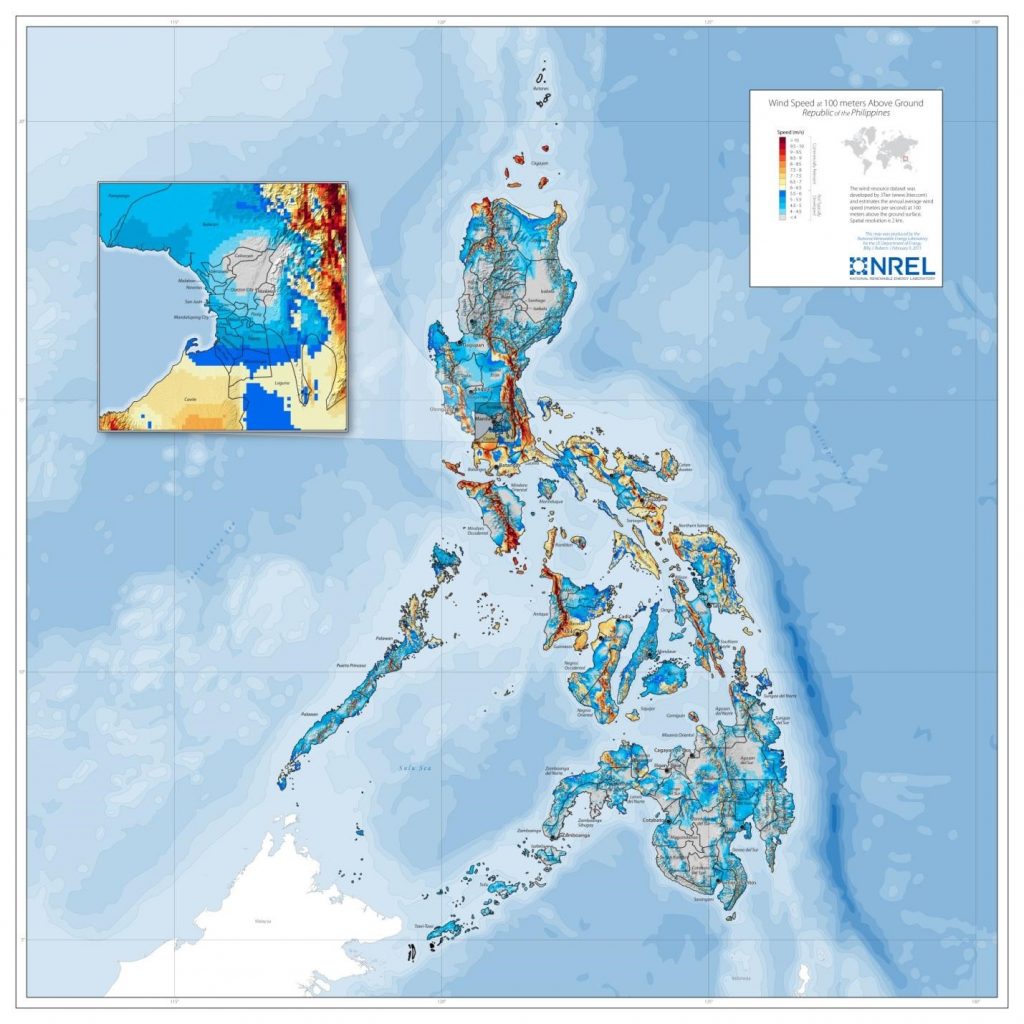
Wind speed at 100 meters above ground in the Philippines
Source: GREENING THE GRID; “WIND RESOURCE MAPS AND DATA”; GREENINGTHEGRID.ORG; WWW.GREENINGTHEGRID.ORG/WHERE-WE-WORK/GREENING-THE-GRID-PHILIPPINES/GREENING-THE-GRID-PHILIPPINES

Hydropower

Hydropower is the leading source of renewable energy in the world generating more than 4,222 terrawatt-hours in 2019.[9] It is expected to remain as the top renewable energy producer in the next few years with growth being led by China and Asia owing to significant global additions.[10]

In the Philippines, hydropower is also the most dominant source of renewable technology. Studies indicate untapped potential reaching 13,097 megawatts. 86% is estimated to be suitable for large hydropower plants in 18 potential sites around the country, while the rest can be mini- and micro-hydropower plants at 888 locations.[11] Figure 44 maps the resource potential in areas across the Philippines according to theoretical capacity. It also highlights how remote mountainous areas that cannot be reached by on-grid power favor hydropower.
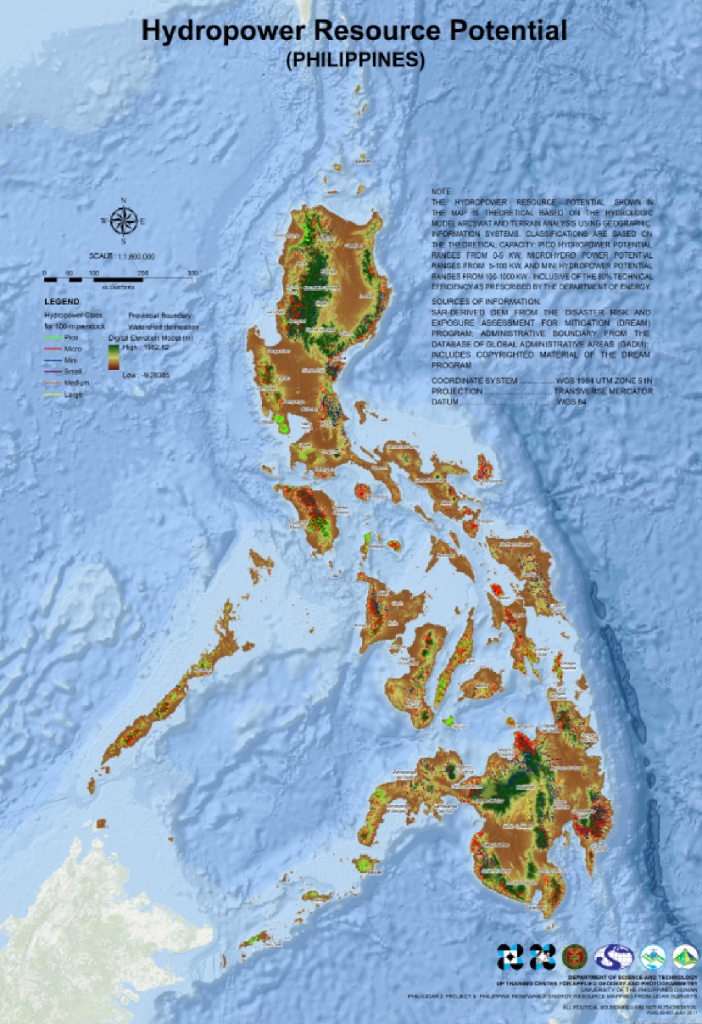
Hydropower resource potential of the Philippines
Source: PHILIPPINE DEPARTMENT OF ENERGY; “NATIONWIDE MAPS”; PHILIPPINE RENEWABLE ENERGY ATLAS

Ocean

Globally, ocean energy is still considered at its infancy with focus on further research and development before it becomes commercially viable.[12] While additional work is still required with this particular type of resource, technical feasibility has already been proven with prototypes and pilot projects.[13]

The exploration of the potential of ocean energy in the Philippines began with a resource assessment conducted by the Mindanao State University in the 1980’s. Their findings indicate that the country’s archipelagic state has the theoretical capacity of 170 gigawatts over a thousand square kilometers of ocean resource area.[14] DOE has identified 16 potential sites around the country to develop OTEC, while 18 other sites are being considered for wave power as shown in Figure 45.

Passage of the RE Law has encouraged interest in ocean energy resulting in three applications being pursued: wave, tidal and OTEC. On the basis of the previous relevant studies, estimated ocean energy generation capacity of 70.5 megawatts was proposed for development in the 2013-2030 Philippine Energy Plan.[15] However, the sites identified in the plan require more detailed exploration studies to ensure technical and economic viability. To date, eight ocean projects have been awarded Luzon (2), Visayas (5) and Mindanao (1). These projects however are still in the pre-development with an indicative total capacity of 26 megawatts
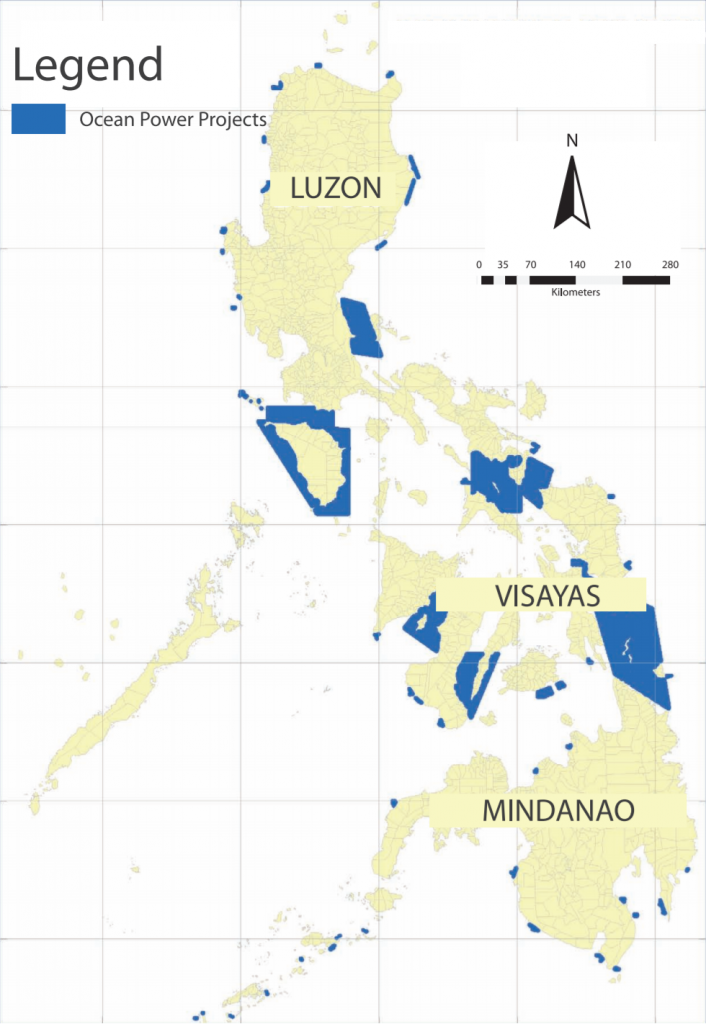
Location map of potential areas for ocean power development
Source: PHILIPPINE DEPARTMENT OF ENERGY; “PLANS AND PROGRAMS”; NATIONAL RENEWABLE ENERGY PROGRAM


[1] Ibrahim Dincer et al., Comprehensive Energy Systems
[2] International Renewable Energy Agency, Renewable Readiness Assessment: The Philippines
[3] Think GeoEnergy, The Top 10 Geothermal Countries 2019 – based on installed generation capacity (MWe), https://www.thinkgeoenergy.com/the-top-10-geothermal-countries-2019-based-on-installed-generation-capacity-mwe/
[4] Adele Manzella et al., Geothermal Energy and Society.
[5] Our World In Data, Renewable Energy, http https://ourworldindata.org/renewable-energy.
[6] IRENA, Future of Solar Photovoltaic.
[7] IRENA, Renewable Readiness Assessment: The Philippines.
[8] IRENA, Renewable Readiness Assessment: The Philippines
[9] Our World In Data, Renewable Energy, http https://ourworldindata.org/renewable-energy.
[10] IEA, Hydropower, https://www.iea.org/reports/hydropower.
[11] DOE, National Renewable Energy Program
[12] International Energy Agency, Net Zero by 2050.
[13] Ibrahim Dincer et al., Comprehensive Energy Systems.
[14] DOE, National Renewable Energy Program.
[15] IRENA, Renewable Readiness Assessment: The Philippines. 

]]>
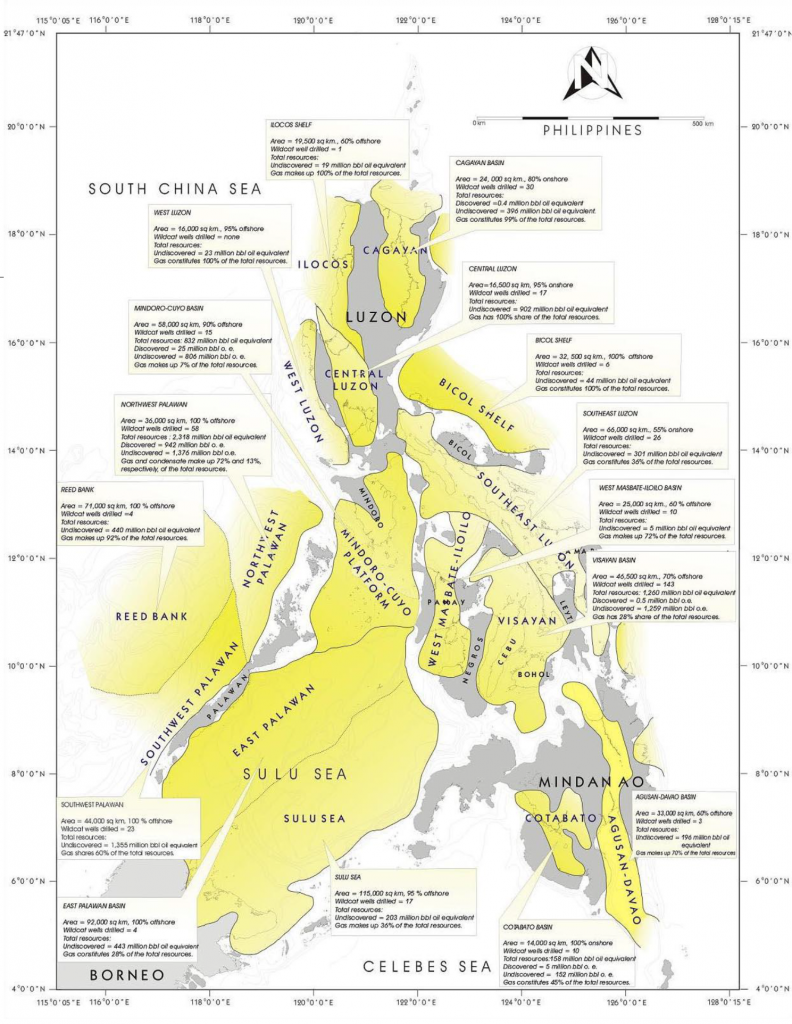
Fossil Fuel Energy https://solarsolutions.ph/portal/fossil-fuel-energy/ Thu, 09 Sep 2021 05:13:27 +0000 https://solarsolutions.ph/portal/?p=537 In the Philippines, fossil fuel potential is found in 16 sedimentary basins covering an area of more than 700,000 square kilometers (km2) with a combined potential of 4,777 million barrels of fuel oil equivalent of oil and gas resources (Philippine Energy Plan). These basins are located in the Ilocos Shelf, Cagayan, Central Luzon, Bicol Shelf, Southeast Luzon, Mindoro-Cuyo, West Masbate-Iloilo, Visayan, Agusan-Davao, Cotabato, Sulu Sea, East Palawan, Southwest Palawan, Reed Bank, Northwest Palawan, and the West Luzon Trough as shown below.

Sedimentary Basins in the Philippines
Source: DOE; “OIL AND GAS”; INVESTMENT OPPORTUNITIES IN THE PHILIPPINE ENERGY SECTOR

Oil

The world’s primary fuel source for transportation is oil. It is mainly formed by decomposing organic matter which settle in large quantities in sedimentary basins over time, but it also exists in shale and tar sands. Most oil is pumped out of underground reservoirs and then processed in refineries to create fuel oil, gasoline, liquefied petroleum gas, and other products like fertilizers, pesticides, pharmaceuticals, and plastics. Oil can cause serious environmental issues through oil spills and is a major source of greenhouse gas emissions.[1]
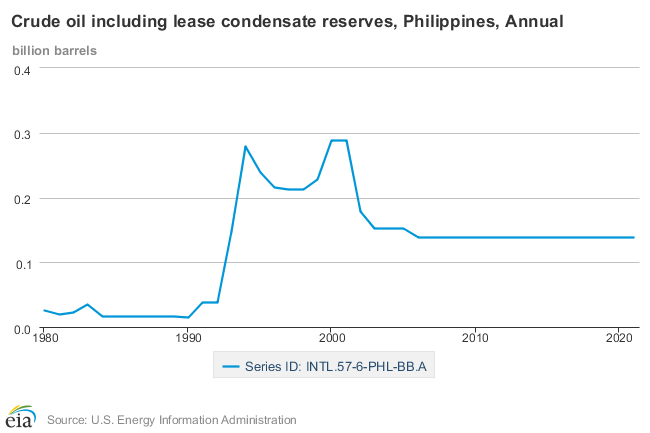
Annual Crude Oil Reserves in the Philippines
Source: U.S. ENERGY INFORMATION ADMINISTRATION, “PHILIPPINES: DATA FOR PETROLEUM AND OTHER LIQUIDS”, WWW.EIA.GOV/INTERNATIONAL/DATA/COUNTRY/PHL

Natural Gas

Natural gas is primarily composed of methane with other hydrocarbons, carbon dioxide, nitrogen and hydrogen sulfide. It is formed when layers of decomposing natural waste material is exposed to very high temperatures and pressures under the earth’s surface for millions of years. Resources are found isolated in natural gas fields in deep rock formations or associated with coal reservoirs as coal bed methane, and in close proximity to and with oil fields.

The Malampaya Deep Water Gas-to-Power project remains the largest source of natural gas in the country since the start of its commercial production in 2002. Its production fuels five natural-gas power plants contributing an average of 20 % of power generation for the Philippines. Malampaya will continue to supply 99% of the country’s natural gas contributing 584,000 million standard cubic feet out of the expected 588,331 million standard cubic feet between 2019 to 2022.[2]
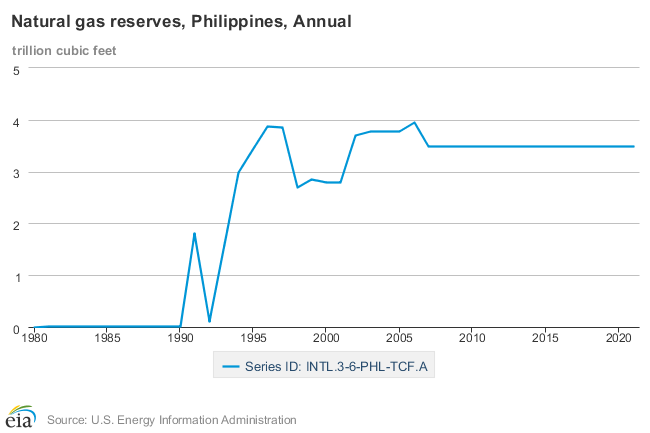
Annual Natural Gas Reserves in the Philippines
Source: U.S. ENERGY INFORMATION ADMINISTRATION, “PHILIPPINES: DATA FOR NATURAL GAS”, WWW.EIA.GOV/INTERNATIONAL/DATA/COUNTRY/PHL

Coal

Coal is the largest source of energy for the generation of electricity worldwide, accounting for approximately 38.4% of global electricity generation in 2017 due to abundance, low cost and ability to generate base load electricity.[3] Producing electricity as well as heat is achieved through the burning of coal, which at the same time releases a harmful amount of carbon dioxide into the atmosphere. The process of mining coal is also damaging not only to the environment with the chemical waste it releases into the rivers and streams, but also to human health.
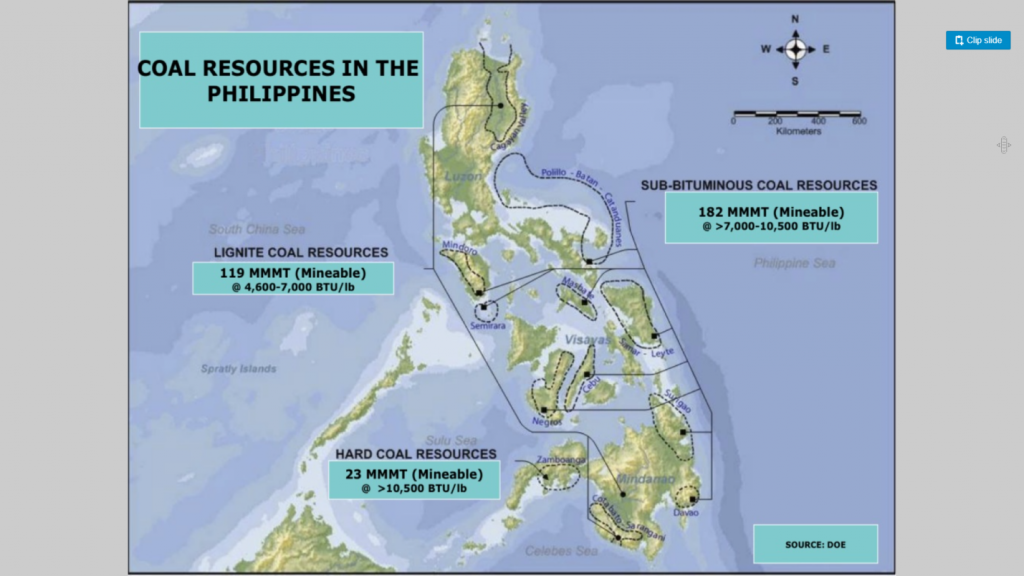
Coal Resources in the Philippines
Source: ASIAN INSTITUTE OF TECHNOLOGY; “ENERGY RESOURCES INDUSTRY PHILIPPINE UPDATE”; OVERVIEW OF GLOBAL AND PHILIPPINE ENERGY OUTLOOK

[1] Ibrahim Dincer et al., Comprehensive Energy Systems, 526.
[2] DOE, Philippine Energy Plan 2018-2040, 62, 64.
[3] DOE, Philippine Energy Plan 2018-2040, 66.
]]>